Expulsion from the USSR & Leningrad Writers Unions
- 17-1. Lydia Chukovskaya
- 17-2. Vladimir Voinovich
- 17-3. Dismissal of Yefim Etkind
*
expelled from the USSR Writers’ Union
In March 1974, the Newsletter of the USSR Writers’ Union Board Secretariat (an internal publication) contained the following announcement:
In the Secretariat of the Board of the Moscow Writers’ Organization
“The disciplinary case of L.K. Chukovskaya was discussed at a meeting of the Board Secretariat of the Moscow Writers’ Organization.
“In the course of the discussion it was established that for a number of years L.K. Chukovskaya had flagrantly violated the basic principles of the Statutes of the USSR Writers’ Union, and had engaged in the fabrication of articles and other materials which had been published in various organs of the press hostile to the Soviet Union.
“In accordance with the Statutes of the USSR Writers’ Union, a unanimous decision was adopted to expel L.K. Chukovskaya from membership of the USSR Writers’ Union.”
*
Lydia Korneyevna CHUKOVSKAYA is author of In an Editor’s Laboratory and of numerous historical and literary studies (about Herzen, the Decembrists and others).
Her critical articles have been published in the Soviet press.
Her novellas The Deserted House (about the Year 1937) and Going Under have been published abroad, and circulate in the USSR in samizdat. She has written many samizdat essays: “A Letter to Mikhail Sholokhov” (1966), “Not Punishment, But Thought and Word” (1969), “The People’s Wrath” (1973; CCE 30.15 [6]), and others [1].
The Secretariat meeting was preceded by an examination of her case at a meeting of the Children’s Section Bureau at the Writers’ Union. A resolution was adopted to request the Secretariat to expel her. At the meeting it was said that Chukovskaya had contributed nothing to literature and had been kept in the Union only out of respect for the memory of her father and her brother (Nikolai Chukovsky).
At a preliminary talk with Strekhnin and Mednikov, without being asked, Lydia Chukovskaya recounted how she had personally handed a copy of “The People’s Wrath” to an American correspondent after inviting him to her flat. Her other writings had made their way abroad spontaneously, through samizdat.
*
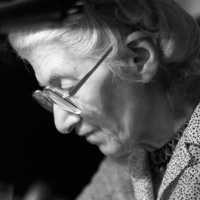
Lydia Chukovskaya (1907-1996)
*
MEETING
The meeting of the Secretariat took place on 9 January 1974. Chukovskaya’s case was discussed for about two hours. Narovchatov was in the chair; Yu. Strekhnin delivered the main report.
About twenty people were present.
Amongst those who spoke were: Nikolai Lesyuchevsky, Alexander Rekemchuk, Yury Yakovlev, Yu. Zhukov, Agniya Barto, Valentin Katayev, Nikolai Gribachev, Mikhail Alexeyev, and Anatoly Mednikov.
As it turned out, nothing was said during the meeting about “transmitting materials to the West”.
The only document read out was Chukovskaya’s written authorization to Zhores Medvedev to receive her royalties. Chukovskaya explained that she needed Western royalties to buy optical aids (Lydia Chukovskaya has very poor eyesight) and medicines.
As far as is known, no disagreements arose between those who spoke.
*
Lydia Chukovskaya was given the floor. Her speech is widely known in samizdat [2]. In particular, she said:
“Expulsion from the Union finally condemns one to the fate of an unperson. I did not and do not exist …
“But shall I go on existing?
“In performing acts of this kind you have always forgotten, and are forgetting now, that only the Present and a part of the Past is in your hands.
“… You cannot rule … by virtue of the word. … With the word you can captivate, cure, bring happiness, expose, cause anxiety, but not rule.
“You can rule only by obstructing the word, impeding the word, damming up the word: by withdrawing a book from publishing plans or from a library; by breaking up the type; by not printing an author, expelling him (or her) from the Union; by transferring a book from the 1974 to the 1976 plan and appropriating the paper for yourselves; or by printing the prose of Filev in a million copies. Those are the sort of actions you rule by.
“… What will the expelled people do? Write books. For even prisoners have written and do write books. What will you do? Write resolutions.
“Go on then: write them.”
*
SOVIET PRESS
“Expel L.K. Chukovskaya from the Union of Writers”, reads the resolution, “with full coverage in the press.”
On 12 January 1974, the newspaper Literary Russia carried a report of the meeting, enumerating all the agenda items, but with no mention of the discussion of Chukovskaya’s case.
On 18 January the newspaper Soviet Russia published a satirical article by Yu. Yurchenko called “’Misha Skameikin’ from London” [3], which mentions Lydia Chukovskaya but not her expulsion from the Writers’ Union.
*
LETTERS OF SUPPORT
It is known that letters in defence of Chukovskaya were sent to the Writers’ Union by I. Varlamova, D. Dar, Lev Kopelev, Vladimir Kornilov, Vladimir Maximov, L. Panteleyev, Andrei Sakharov and Alexander Solzhenitsyn.
We reproduce the 6 January 1974 letter from the poet Vladimir Kornilov.
“I have learned that the Moscow Secretariat is intending to expel Lydia Korneyevna Chukovskaya from the Writers’ Union, a woman who has always been noted for her honesty, talent and courage.
“Lydia Komeyevna Chukovskaya suffers severely from a dangerous heart disease and her sight is almost gone. And you men are persecuting a woman whose only defence is her personal fearlessness.
“Is this humane? Is it manly?”
Vladimir Kornilov
At the end of January 1974, Kornilov was issued with a reprimand for his defence of Chukovskaya.
Chukovskaya has received about thirty personal letters of sympathy.
==============================================
NOTES
- On Chukovskaya’s essays, see CCE 5.1 [9], CCE 22.9 [9], CCE 30.15 [6], and CHR (1973, No. 4).
↩︎ - See full text and related texts in CHR, 1974 No. 7 (see also CHR 1973, No. 4).
↩︎ - Chronicle comment:
“The hero of the article, ‘Misha Skameikin’, is Michael Scammell. An English journalist, he is the editor of the journal Index on Censorship, which publishes uncensored literature from countries where censorship exists (Greece, Yugoslavia, USSR, etc.).
“The Chronicle thinks it should comment also on some other names mentioned in the 18 January Soviet Russia article.
“Lev Kopelev [1912-1997] is a member of the Writers’ Union and the PEN Club, and an old friend of A.I. Solzhenitsyn.
“Vadim Sidur [1924-1986] is a Moscow sculptor and artist. His portrait of Solzhenitsyn is featured in a New York edition of Solzhenitsyn’s works.
“Itkind, in all probability, means the Leningrad literary critic Yefim Etkind (1918-1999)”. (On Etkind, see CCE 32.17-3).
↩︎
=========================
 A Chronicle of Current Events