«Other related documents and texts»
*
A LETTER FROM MOSCOW (8 August 1968)
The original impetus for the creation of the “Index on Censorship” magazine came from an Open Letter addressed “To World Public Opinion” by two Soviet dissenters, Pavel Litvinov and Larissa Bogoraz.
Describing “the atmosphere of illegality” surrounding the January 1968 trial of Ginzburg and Galanskov (CCE 1.2), Bogoraz and Litvinov called for
“public condemnation of this disgraceful trial, for the punishment of those responsible, the release of the accused from detention and a retrial which would fully conform with the legal regulations and be held in the presence of international observers.”
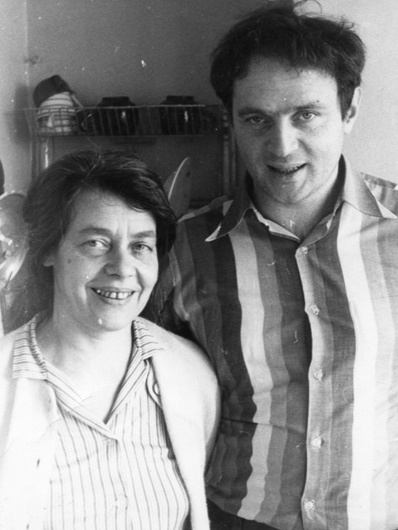
Larissa Bogoraz (1929-2004) and Pavel Litvinov, b. 1940
*
On release, and until his expulsion from the Soviet Union in 1979 (CCE 53.1), Alexander Ginzburg resumed his dissident activities.
His co-defendant, the writer Yury Galanskov, died while still in the camps (CCE 28.1).
*
The Bogoraz-Litvinov Appeal was translated and published in The Times (London).
In response the English poet Stephen Spender composed a brief telegram, for which he secured the support of 16 British and US intellectuals:
“We, a group of friends representing no organisation, support your statement, admire your courage, think of you and will help in any way possible.”
Among those who added their signatures to this message were the poet W.H. Auden, philosopher A.J. Ayer, musician Yehudi Menuhin, man of letters J. B. Priestley, actor Paul Scofield, sculptor Henry Moore, philosopher Bertrand Russell, writer Mary McCarthy, composer Igor Stravinsky and George Orwell’s widow Sonia (née Brownell).
Later that year, on 25 August, Bogoraz, Litvinov and six others demonstrated on Red Square (CCE 3.3) against the invasion of Czechoslovakia.
*
On 8 August 1968, two weeks before the invasion, Pavel Litvinov sent a letter to Spender.
It was published several years later in the first issue of Index on Censorship (May 1972). Litvinov suggested setting up
“… an international committee or council that would make it its purpose to support the democratic movement in the USSR. This committee could be composed of universally respected progressive writers, scholars, artists and public personalities from England, the United States, France, Germany and other western countries, and also from Latin America, Asia, Africa and, in the future, even from Eastern Europe. …
“Of course, this committee should not have an anti-communist or anti-Soviet character.
“It would even be good if it contained people persecuted in their own countries for pro-communist or independent view. … The point is not that this or that ideology is not correct, but that it must not use force to demonstrate its correctness.”
As part of this proposal Litvinov suggested that a regular publication might be set up in the West “to provide information to world public opinion about the real state of affairs in the USSR”.
*
Spender and his colleagues Stuart Hampshire, David Astor and Edward Crankshaw and Michael Scammell (the founding editor of Index) liked the idea. But they decided to cast their net wider.
They wished to document patterns of censorship all over the world, in right-wing dictatorships — the military regimes of Latin America, the south European dictatorships of Greece, Spain and Portugal — as well as the Soviet Union and its satellites.
*
Title, scope, relations with Amnesty International
Meanwhile, in 1971, Amnesty International began to publish English translations of each new issue of A Chronicle of Current Events, with its regular “Samizdat Update”.
In a recent interview, Michael Scammell explained the informal division of labour between the two London-based organisations:
“When we received human rights material we forwarded it to Amnesty; and when Amnesty received a report of censorship they passed it on to us”.
Originally, as suggested by Scammell, the magazine was to be called Index, a reference to the lists or indices of banned works that are central to the history of censorship: the Roman Catholic Church’s Index Librorum Prohibitorum (Index of Forbidden Books); the Soviet Union’s Censor’s Index; and apartheid South Africa’s Jacobsen’s Index of Objectionable Literature.
Scammell later admitted that the words “on censorship” were added as an afterthought when it was realised that the reference would not be clear to many readers. As Scammell wrote, in the December 1981 issue of the magazine,
“Panicking, we hastily added the words ‘on Censorship’ as a subtitle, and this it has remained ever since, nagging me with its ungrammaticality (‘Index OF Censorship’, surely?) and a standing apology for the opacity of its title.”
*
As the summer Olympic Games in Moscow approached, Index on Censorship prepared an entire issue devoted to the USSR (15 August 1980).
======================================================
SOURCES
Michael Scammell, “How Index on Censorship Started”, in George Theiner (ed.), They Shoot Writers, Don’t They? (Faber & Faber: London, 1984), pp. 19-28.
=============================
 A Chronicle of Current Events