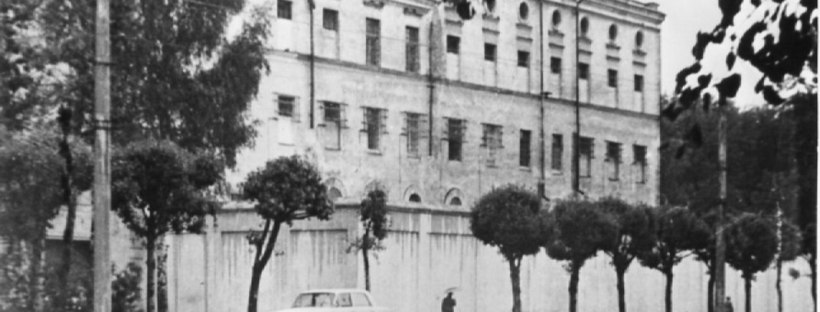
Vladimir Trifonov (CCE 26.5) is now undergoing compulsory treatment in the Leningrad SPH (Special Psychiatric Hospital; he was charged under Article 190-1, RSFSR Criminal Code); he has been diagnosed as suffering from paranoia.
He does not consider himself ill, and in recent years has been refusing to go to sessions of the psychiatric commission. He does not want, he says, to take part in such a farce.
*
CHINNOV
Anatoly Fyodorovich CHINNOV (CCE 26.5) was first held for forcible treatment in the Dnepropetrovsk SPH; then he was transferred to the Leningrad SPH on Arsenalnaya Street. In 1972 he was transferred back to Dnepropetrovsk.
Prior to his arrest Chinnov was a student of Vladimir Solovyov’s works. He embraced Solovyov’s philosophy and became an Orthodox Christian. He considered that it was impossible to lead a Christian life in the USSR, and therefore he tried to leave the country.
In the Dnepropetrovsk hospital, Chinnov was subjected to electric-shock therapy, a full course of treatment, and then to insulin therapy (30 shocks). In Leningrad he was at first given drugs in small doses, and then the medical treatment stopped altogether.
On his return to Dnepropetrovsk, however, he was again prescribed drugs in tablet form. During the periods of compulsory medical treatment Chinnov’s health sharply deteriorated; he developed chronic gastritis, he became abnormally emaciated and he lost half his teeth. Psychiatric commissions have been prolonging his compulsory treatment, since he does not wish to renounce his religious and philosophical views.
Chinnov’s sister asked for him to be released into her supervision, but she was told this would only be possible after he was discharged from the hospital.
On 30 January 1974 a psychiatric commission again extended Chinnov’s “treatment in a special psychiatric hospital”.
*
Kim Davletov (CCE 24.11 [3], CCE 25.10) is undergoing compulsory treatment in the Kazan SPH (Tatarstan).
Davletov (b. 1932) was arrested on 7 December 1971 because of the publication in Albania of his Stalinist-line booklet. Before his arrest his address was: Moscow, 7 Polyarnaya Street, flat 69.
*
Yury Belov (CCE 26.5, CCE 27.5) is in the Sychovka SPH (Smolensk Region). He is being given haloperidol, although the doctors themselves see no medical necessity for this.

Yury Belov*
For instance, Albert Lvovich Zeleneyev, a doctor in the fourth section of the hospital, said to Belov:
“You don’t need medical treatment, but if we don’t give you any treatment, then when you leave you’ll say that you were healthy and that no treatment was prescribed for you.”
Kholodkovskaya, a representative of the Serbsky Institute, stated at a session of the psychiatric commission in the spring of 1974: “We cannot find anything medically wrong with you, but we cannot discharge you.”
She explained: “We consider religious convictions to be a form of pathological illness and so we try to treat you for them,” Belov was forbidden to have a pen. His access to books was also restricted: parcels of books addressed to him were often returned. His correspondence was restricted, and his letters frequently went astray.
At the latest session of the psychiatric commission in December 1974 Belov’s term of confinement to a special hospital was once more prolonged, although the hospital doctors had recommended him for discharge.
[* This photograph was taken by Yury Grimm for inclusion in Alexander Podrabinek’s Punitive Medicine, 1979.]
*
Konstantin Petrovich MALYSHEV is also being held in the Sychovka SPH.
He is 45 years old and was chief engineer of the town economic committee of Kulebaki (Gorky Region). Malyshev was charged under Article 190-1 for his complaints to higher authorities.
*
KUKOBAKA
A few months ago, Mikhail Kukobaka (CCE 27.5) was transferred from the Sychovka SPH to an ordinary psychiatric hospital in the city of Vladimir. Mikhail Ignatevich KUKOBAKA was arrested on 14 April 1970 in the small city of Alexandrov (Vladimir Region).
During a search of the hostel where he lived, an exercise book containing his article “An Open Letter to the English Writer Ivor Montagu” was confiscated. The investigation was at first conducted by the City Procurator’s Office, Senior Investigator Fedosov: it can be supposed that the investigation related to Article 190-1 (RFSFR Criminal Code). An out-patient psychiatric diagnosis found Kukobaka to be responsible. After Kukobaka refused the lawyer assigned to him, and also refused to sign Article 201 of the Code of Criminal Procedure, he was transferred to Vladimir Prison, and his case was handed over to the Regional KGB.
The investigator, Major Yevseyev, head of the KGB investigation department in Vladimir Region, sent Kukobaka to the Serbsky Institute in Moscow for a psychiatric examination. From September 1970 to autumn 1971 Kukobaka was again held in Vladimir Prison, ignorant of his own legal position and of the results of the psychiatric examination. Only in September 1971, after many written protests on his part, was he told by the prison’s special section that he had been ruled to be mentally non-responsible, and that on 4 November 1970 a court had ordered that he be sent for compulsory treatment to a special psychiatric hospital. In early November 1971 Kukobaka was sent to the Sychovka SPH, where he remained for around three years without receiving any medical treatment.
In ordinary psychiatric hospital in the Vladimir (its KGB supervision is conducted by Captain Vinogradov) Kukobaka is not allowed to receive parcels containing books about history, philosophy or politics, or textbooks on foreign languages. He is forbidden to study Esperanto.
*
MORDOVIA
The psychiatric unit in the Mordovian camp-complex is at the following address: Barashevo, Tengushevsky district, ZhKh 385/3-2, korpus 12. The head of the department is V.V.(?) Kokorev.
Convicts without medical training work in the psychiatric unit as orderlies. They are allowed to hand out drugs and even to give injections of sulphazin. The orderlies practise extortion and steal from the patients; they also beat them.
Many of the orderlies are drug-addicts. The building is in a dilapidated, unsanitary condition. The duty doctor for the zone, and the administration officials, never visit it. Statements and complaints written by the patients are never delivered — not even to the camp administration. The following are patients there:
Albert Kuzmich UGNACHEV (b. 1938) was sentenced under Article 58 (Stalin-era Criminal Code), and has already been imprisoned for 17 years. Ugnachev was diagnosed as schizophrenic at the Serbsky Institute. Ugnachev is due to be sent to a special psychiatric hospital.
Sakulsky: Article 70 of the RSFSR Criminal Code.
Algirdas Pranas ZIPRE (see CCE 32.12, where his name was given incorrectly; b. 1927) has been in the Serbsky Institute since 29 July 1974.
Zipre’s sister Jadviga Jakubeniene has sent an appeal to the USSR Procuracy and to the Latvian SSR Procuracy, requesting that the procurator for supervision visit her brother and acquaint him with the documents in his case. Jakubeniene gave as the reason for this request the fact that the doctors have noted only one symptom of mental illness in her brother: his complaints since January 1973 about his illegal detention which he writes because, first, he is convinced that he was wrongly sentenced, and second, because he has received no reply to his complaints for one-and-a-half years.
*
In January 1974 Ozhegov (b. 1939) from Tyumen, Article 70 (RSFSR Criminal Code) was in the Serbsky Institute for a psychiatric diagnosis.
*
In November 1974 Pyotr Starchik (CCE 28.5) was transferred from the Kazan SPH to an ordinary psychiatric hospital in Moscow (Hospital No. 15).
*
In November 1974 the Moscow City Court ordered the release of Roald Mukhamedyarov (CCE 29.10) from compulsory medical treatment.
*
In October 1974 Vladimir Gershuni was released from an ordinary psychiatric hospital (CCE 32.13).
*
Concerning Leonid Plyushch
In the summer of 1974 mathematicians abroad came to the support of Leonid I. Plyushch. The Soviet embassy in Washington received a petition signed by 650 American mathematicians.
Lipman Bers, a member of the International Committee of Mathematicians for the Defence of Plyushch, said in an article published in Annals of the American Mathematical Society (Volume 21, No. 6, October 1974), that the petition of 8 July was returned to the senders.
In a letter signed by V. I. Kuznetsov, Second Secretary at the Embassy, this was said to be because of the petition’s “hostile and slanderous character”. Bers writes:
“Mr Kuznetsov did not succeed, however, in pointing out even one inaccuracy in the Committee’s statements.”
*
In August Academician Sakharov appealed to the International Congress of Mathematicians, taking place in Vancouver (Canada), calling on them “to do everything possible to save Leonid Plyushch”.
On 24 August five members of the Committee for the Defence of Plyushch: M. Atiyah (England), L. Bers (USA), H. Cartan (France) and I. Halperin (Canada) organized a meeting at which they agreed on the texts of a petition to Kosygin and a telegram to Sakharov. The petition, containing an appeal for the release of Plyushch and also asking that his family be given the possibility of choosing his form of medical treatment, was signed by 900 participants of the Congress.
Sakharov did not receive the telegram sent to him on 27 August.
*
In October 1974, when Plyushch was no longer being treated with insulin, and no new drug had yet been prescribed, his doctors suggested to him that he should write a statement condemning his “anti-Soviet activities” after the manner of Yakir and Krasin.
Plyushch categorically refused to do so: “Yakir lied: Do you want me to become a liar?” No further suggestions of this kind were made to him and there was no further discussion. Soon a new treatment was prescribed for him — large doses of triftazin in tablet form.
*
On 13 November 1974 a non-scheduled medical commission, led by the chief psychiatrist of Dnepropetrovsk Region, visited the Dnepropetrovsk SPH. The hospital administration told Tatyana I. Zhitnikova, Plyushch’s wife, that this commission had been organized on her petition. Only Plyushch was interviewed by the commission. He was asked three questions:
Q. How do you feel?
Much the same as always.
Q. Do you have any complaints?
I have started to have pains in my chest.
Q. What do you know about Valentyn Moroz?
What a strange question! What can I know about anyone when I’m completely cut off from the world?
*
The commission decided that it was necessary to continue the compulsory treatment of Plyushch and his treatment with triftazin.
On 15 November 1974 Plyushch was put into a “surveillance” ward, where he was lodged with more than 20 aggressive mental patients. In that ward the light is never switched off. The patients are never taken outside: even the lavatory is in the ward.
From 15 November onwards, Plyushch was given triftazin by injection. The injections of triftazin induce in him drowsiness (but the light makes it difficult to sleep), inertia, and constant shivering. Plyushch does not go for walks — it is not known whether this is because he is not able to do so, or because he is not allowed to.
During a scheduled visit, Plyushch hardly said anything and asked no questions even about his children. He has almost stopped writing letters: only one letter from him was received last month.
*
APPEALS
On 16 December 1974 Tatyana Khodorovich, Grigory Podyapolsky, Yury Orlov (corresponding member of the Armenian SSR Academy of Sciences), the geologist Malva Landa and the psychologist Boris Landa made an appeal to:
“the scientific academies of various countries and professional associations of jurists, psychiatrists and journalists”.
“The torture of the mathematician Leonid Ivanovich Plyushch in a special psychiatric “hospital” is exactly the same kind of revolting crime as the experiments carried out on living people in Hitler’s Germany …
“We appeal to all persons who prize the human intellect and conscience to defend L. I. Plyushch from such outrages by sending protests to the Soviet government.”
*
On the same day Tatyana Khodorovich made a statement “To the press, to mathematicians and psychiatrists”. The statement ended with these words:
“… In the name of humanitarian solidarity and professional brotherhood, in the name of reason and human dignity, in the name of compassion and justice — please HELP Leonid Plyushch and his family to leave the Soviet Union.”
*
On 19 December 38 people issued a “Statement to the Press” urging: “Do not give up, continue the campaign to free Leonid Plyushch!”
On 20 December T. Khodorovich and Yury Orlov appealed to the “International Committee of Mathematicians for the Defence of Plyushch”:
“We call your attention to the special danger in the fact that in a huge country, possessing great power, the forcible and uncontrolled use of modern drugs for the purpose of ‘correcting’ the free intellect and destroying the conscience has become a custom.
“We appeal to you to send to the Ministry of Internal Affairs, the Committee of State Security, the Soviet government and the Supreme Soviet your protests and demands that the compulsory “treatment” of Leonid Plyushch be ended at once.
“Demand the release of L. Plyushch from his psychiatric prison!”
*
On 20 December 1974 Zhitnikova handed the procurator of Dnepropetrovsk Region a statement calling for the initiation of criminal proceedings against:
- F. K. Pruss, the director of the Dnepropetrovsk hospital [SPH];
- Dr L. A. Chasovskikh, head of the hospital’s ninth section; and
- E. P. Kamenetskaya, Plyushch’s former doctor and the head of the hospital’s 12th section.
They should be charged with deliberately destroying “the physical and mental health of L. I. Plyushch by means of forcible doses of drugs over a lengthy period in unsanitary conditions”.
On the same day Tatyana Khodorovich and Yury Orlov appealed “To the International Commission of Jurists and to all professional bodies of psychiatrists”. (The text of the appeal was agreed upon in advance with Zhitnikova by telephone.)
“We appeal to international, independent associations of jurists and psychiatrists to provide L. Plyushch’s wife with a lawyer and a consultant-psychiatrist to take part in a legal action which she is initiating against the medical personnel of the Dnepropetrovsk Special Psychiatric Hospital … Plyushch’s wife asks especially for the participation of the London psychiatrist Gery Low-Beer in this legal action.”
After Zhitnikova made her next visit to the hospital, she wanted to buy a ticket to Moscow at the Dnepropetrovsk railway station. She was told by the cashier, who apologized, that although there were seats on the train to Moscow he had for some reason been forbidden to sell tickets for it.
Zhitnikova then took a bus from Kiev to Moscow, but the bus was stopped in the suburbs of Kiev by police and Zhitnikova was forced to get out.
*
On 27 December 1974 Plyushch’s injections were stopped. As a result of the suspension of treatment Plyushch’s health at once improved somewhat. However, he was not transferred from the “surveillance” ward.
===============================================
 A Chronicle of Current Events