Tashkent Region Court, 21-28 November 1972
Charges:
Article 190-1 (RSFSR Criminal Code), Article 191-4 (Uzbek SSR Criminal Code)
and Article 203-1 (Tadzhik SSR Criminal Code).
Sentence: three years imprisonment in an ordinary-regime camp.
Judge M.M. Maksumov, lay assessors N.A. Korzh and M. Kamilova;
prosecutor, Tashkent Regional procurator K. Galashko; defence lawyer, S.S. Lukyanov.
*
Dzheppar (Dzhabar) Akimov was born in 1909 in Tuak village near Alushta (Crimea).
A teacher by education, he worked until the Second World War in schools and in the Crimean ASSR’s Commissariat of Education. Then he was an editor, at the Crimean State Publishing House and with the Kyzyl Krym newspaper. He became a Communist Party member in 1939.
At the beginning of the war, in evacuation, he was appointed chief editor of Kyzyl Krym. In 1942 Akimov was sent over to the partisans, where he published leaflets in the Tatar language.
In May 1944 [1], Akimov was deported to the town of Bekabad in eastern Uzbekistan, where he lived until his arrest on 29 August 1972.
In 1944-1948 Akimov worked as deputy head in the political section of the Farkhad railway; then, until his retirement, he served as an economist and planner in various institutions.
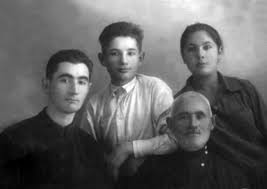
Dzheppar Akimov (1909-1983), left
An active figure in the Crimean Tatar movement, Akimov was was expelled from the Party in 1968.
In 1966, Akimov was one of 65 Crimean Tatar representatives delegated to deliver statements to the 23rd Party Congress (this issue CCE 31.10). He repeatedly took part in meetings of representatives of the Crimean Tatars in Central Asia and in Moscow. All these activities, alongside his suspected authorship of several statements, formed the charges against him at his trial.
*
INVESTIGATION
The grounds for instigating proceedings against Akimov, however, were at first different.
On 18 May 1972, black flags bearing the words “18 May is the day when Crimean Tatars were expelled from their homeland” were hung out in Bekabad, Uzbekistan. (Evidently, the CCE 27.2 [8] report that Akimov himself hung out the flags was mistaken.)
An investigation was opened. It was entrusted to Investigator Berezovsky who had specialized over a long period in affairs of the Crimean Tatar movement [see Grigorenko investigation, CCE 9.6]. On 19 May several searches were carried out in Bekabad (this issue, CCE 31.19) and two copies of an appeal “49 years since the Leninist decree on the formation of the Crimean ASSR”, bearing corrections in his hand, were confiscated from Akimov. First he was made to sign a written undertaking not to leave town. Then on 29 August 1972, Akimov was arrested.
His arrest provoked collective letters of protest.
One, addressed to Chairman of USSR Supreme Soviet Podgorny and Procurator-General Rudenko was titled, “Freedom for our fellow-countryman, Dzhabar-Aga”. The hanging out of a black flag, the letter said, was organized by the KGB to create a pretext for conducting searches of Akimov’s home and then placing him under his arrest. Emphasising the Communist convictions of Akimov and his military and civic services, the authors wrote:
“And such a man…was summoned to the KGB as a witness but did not return home again. We ask you to look into the substance of the case, to free at once the innocently and illegally arrested Akimov … And in order to put an end to all this political terror which is constantly oppressing the people it is necessary to resolve the Crimean Tatar national question without delay.”
The case against Akimov was then separated from the affair of the flags. On 24 October 1972, the investigation concluded with his prosecution under Article 190-1 (RSFSR Criminal Code) and the identical articles of the criminal codes of the Tadzhik and Uzbek Soviet Socialist Republics.
Akimov was charged with:
- four “Information Sheets” signed by himself (5, 8, 25 and 108) about meetings of Crimean Tatar representatives (this issue CCE 31.11, CCE 31.15 and CCE 31.16);
- his own participation in these meetings;
- and co-authorship of two appeals, that mentioned above and one in connection with the 50th anniversary of the USSR (CCE 31.17).
*
INDICTMENT
In the indictment Berezovsky established the illegal character of these materials with the forceful formula:
“The presence of knowingly false fabrications which defame the Soviet political and social system is confirmed by the content of the documents enumerated in the indictment and attached to the case as material evidence.”
Despite the exhaustive character of this formula, it was pointed out that two of the “Information Sheets” or Newsletters (5 and 8) had already been ruled to be defamatory at another trial: the case of Bairamov, Bariyev et al., sentenced on 5 September 1972 [2].
Furthermore, one or two quotations were cited from each item. For example, in Information Sheet 8 “Akimov and other representatives of action groups knowingly make false assertions that dozens of Crimean Tatars are allegedly languishing in prisons up to the present day”;
in the appeal “49 years since the Leninist decree…”
“false aspersions are cast on the position of the Crimean Tatars in the USSR, to the effect that their national equality has allegedly been violated … slanderous fabrications are cited about how after the deportation of the Tatars from the Crimea ‘there started a nightmarish life in reservations and exile.”
Berezovsky proved the co-authorship of Akimov by the confiscation of documents in searches made at the homes of seven other people, by Akimov’s personal signature and his correction of two pages, and by the testimonies of several witnesses about the participation of Akimov in the discussion of the documents.
The charge of inciting activity made use of statements about the great authority of Akimov amongst the Crimean Tatars. The indictment referred to the court a list of 37 witnesses.
*
TRIAL
The trial began on 21 November 1972. Relatives and witnesses were only alerted to this the evening before. The small hall accommodated, not counting police officials, only the wife and brother of Akimov. However, on this occasion a protest (to the Uzbek Procuracy) had an effect; on the second day of the trial the session was transferred to a large hall and the public were admitted.
There were significant difficulties with the choice of a defence counsel. The lawyers from Moscow who agreed to conduct the case were strictly forbidden to do so by the city’s Bar Association. In Tashkent a barrister had to be replaced actually on the day of the trial, and because of this the proceedings were twice interrupted and the examination of the case essentially took place on 27 and 28 November, beginning with the interrogation of witnesses. The questions urged the witnesses to give the “necessary” evidence, but the result was often far from this.
In his evidence Akimov, after telling the court his biography, talked about the tragic position of the Crimean Tatars under the system of punitive surveillance and about how even after the 20th Party Congress (1956) they had remained in the places of special settlement. He declared:
“The documents signed by me express the will and aspiration of the Crimean Tatars, their content does not distort Soviet reality, but merely reflects a situation that actually exists concerning the national question. This movement is legal and inevitable; I therefore consider the charges brought against me to be unfounded and illegal.”
The prosecutor K. Galashko contended that the Crimean Tatars were satisfied with their position and that their movement had been provoked only by incitement. He did not discuss the content of the documents with which Akimov was charged.
Defence counsel Lukyanov, without mentioning the motives for Akimov’s participation in the movement of the Crimean Tatars and without disputing the assertions about the defamatory character of the documents, insisted that neither the authorship of Akimov nor his participation in the dissemination of documents had been proved at the trial.
In his final address Akimov spoke about the reasons for the emergence of a national movement of Crimean Tatars, about the legality and justice of their appeals to Party and Soviet bodies, and declared:
“I am still a Communist and a Leninist, and I remain with my people …”
*
VERDICT
In the verdict it was maintained that “Akimov is one of the organisers and instigators of the so-called movement for the return of all Tatars to the Crimea”.
It was ruled to be proven that Akimov had participated “in illegal and anti-social get-togethers” and in the preparation and dissemination of six documents, reference being made to the evidence of witnesses Ablayev, Seidkhalilov, Z. Shugu and others.
It was also written:
“The accused Akimov, D.A., does not deny that he corrected documents and appealed at a meeting for support of the position of an action group and for the signing of information sheets which he himself had signed.
“In his explanation, D.A. Akimov did not regard this activity as involving fabrications which defamed the Soviet political and social system, and therefore maintained that there was no corpus delicti.”
“Considering that the crime committed was systematic and socially dangerous and resulted in the involvement of other persons”. the court handed down the maximum sentence of three years, despite mitigating circumstances (Akimov had no previous convictions).
*
In some “critical comments on the trial” appended to the record, defence counsel Lukyanov pointed out that the replies to his questions of many witnesses, including some named in the verdict, had not been recorded. These witnesses had said that they had not been present at various meetings and did not know who had composed the information sheets and appeals.
According to Lukyanov’s “critical comments”, certain testimonies in the record had been invented. In the appeal, and in a later complaint to the procurator of the Uzbek SSR, Lukyanov asked for the sentence to be revoked and the case closed: the charges had not been proven: the correction and discussion of previously prepared documents did not signify authorship or co-authorship. The conclusions of the court about authorship were built not on proofs, said Lukyanov, but on suppositions.
Both the appeal and the complaint were unsuccessful.
♦
In December 1973 a group of Crimean Tatar representatives delivered protests to the CPSU Central Committee against the imprisonment of Akimov, signed by many Crimean Tatars living in Uzbekistan. They also sent a telegram of protest on his behalf (this issue CCE 31.24).
The case of Akimov prominently mentioned in a declaration of the Crimean Tatar people (this issue, CCE 31.22) sent to Soviet bodies and to the UN.
=================================
NOTES
- In May 1944, the entire Crimean Tatar nation was deported from Crimea and wherever else its representatives might be to Central Asia and elsewhere. Unlike many other nations deported during the war (Chechens, Kalmyks etc.) they were not freely allowed to return to their historic homeland until the late 1980s.
↩︎ - An error. Sentence in the trial of Bairamov, Bariyev and others was pronounced earlier, on 5 August 1969 (see CCE 9.2 and other sources).
↩︎
==============================
 A Chronicle of Current Events