See Map 3, Dubrovlag
*
UKRAINIANS
Petro Samofil – his 25-year sentence ends on 21 February 1972.
Since his conviction in 1957, Samofil has passed through the Northwest Russian and Siberian camps of Pechora, Vorkuta and Taishet and the strict-regime camp in Spasskoye (Kazakhstan).
He is completing his sentence in Mordovia.
*
Yevhen Prishlyak (Ukr. Pryshlyak) is serving a 25-year term [1].
*
Mykhaylo Lutsik (Ukr. Lutsyk) was arrested by the Germans in 1939 and spent two years and three months in prison.
Later Lutsik was arrested by the KGB in 1944 and spent the years until 1956 in prison, when he was legally exculpated.
In 1957 he was arrested again and given a 15-year sentence. (Biography, CCE 51.22, December 1978.)
*
Members of UPA (Ukrainian Insurgent Army)
Mykola Habarak, Oleksa Kyselek, Ivan Ilchuk, Vasyl Zhovtovolovsky (sentenced to 20 years), Vasyl Yakubyak, Dmytro Basarab, Dmytro Zalesky (sentences unknown).
*
Nikolai Bondar was sentenced to seven years.
As a protest against his sentence Bondar carried out a 34-day hunger strike at the end of 1971 (CCE 23.7 [5]).
*
LITHUANIANS
Petras Paulaitis. He has repeatedly refused to request a pardon [2].
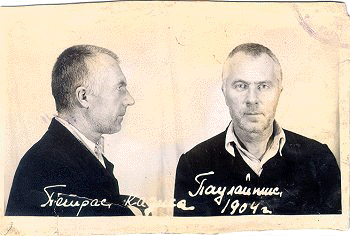
Petras Paulaitis, 1904-1986
*
Jonas Simokaitis. During his trial and the long period spent in transit prisons he has developed //spots on the lungs. He is in Special-Regime Camp 10 [3].
*
Balys Gajauskas. His 25-year sentence ends in May 1973.
Gajauskas has passed through the Balkhash, Dzezkazgan (Kazakh SSR) and Mordovian camps (Nos 7, 11 & 17); he has also been held in Vladimir Prison. While in the camps he learnt more than ten languages.
*
Jonas Matzevicius and Vitas Sidoris. Both serving 25-year sentences.
*
AN ESTONIAN
Willi Saarte (b. 1942) was convicted for attempting to form an Estonian party with the aim of achieving the independence of Estonia. On 24 November 1970 Saarte was sentenced to 4 ½ years in strict-regime camps. He is in Camp 17.
*
A Uniate priest
Father Roman Bakhtalovski was sentenced to three years imprisonment and five years in exile for anti-Soviet propaganda. Manuscripts of sermons for believers were discovered in his possession.
On Bakhtalovski’s birthday, 13 December 1968, KGB officials burst into his home in Kolomiya (Ivano-Frankovsk Region, West Ukraine). They carried out a search, in the course of which they confiscated a carefully preserved fragment of the cross of Christ.
On completing his sentence, at the age of 70, Father Bakhtalovski was sent into exile [4].
*
JEWS
The plight of Jewish prisoners in Dubrovlag Camp 19 who were convicted at recent “Zionist” trials (1970 & 1971, CCE 17.6-1, CCE 20.1) has deteriorated sharply. This follows a visit by Major Sorokin of the Political Department on 24 November 1971.
Sorokin called on the prisoners to struggle against “Zionist sects”.
Victor Boguslavsky was put in the punishment cells on a charge of “sectarianism” for associating normally with other Jews.
Sorokin’s prompting provoked a lively response from those prisoners who were formerly policemen or torturers under the German occupation. On 28 November 1971 prisoners Goldfeld and Yagman sent USSR Procurator-General Rudenko a statement on the persecution of Jews and the arbitrary behaviour of the camp administration.
*
In Camp 3 prisoners are persecuted for studying Hebrew.
Mogilyover was summoned by Captain Pichugin, commander of the operations group, and told in an insulting manner that Jews must stop studying Hebrew, since they were Russian Jews.
The serious plight of Silva Zalmanson and the administration’s arbitrary treatment of Izrail Zalmanson (he has been deprived of visits), are the subjects of a statement addressed by their brother Samuil Zalmanson to N.V. Podgorny, chair of the USSR Supreme Soviet Presidium [5].
==================================
NOTES
- On Pryshlyak (b. 1913), Lutsyk and Ilchuk (b. 1925) see Michael Browne (ed), Ferment in the Ukraine (1971), and the Ukrainian Herald (No 4).
↩︎ - See the portrait of Paulaitis drawn by Yury Ivanov in Mordovia’s special-regime Camp 10 (Possev 2, 1971).
Born in 1904, Paulaitis studied in Rome, gained a doctorate, and was then active in the underground, first against the Nazis (1940-44), then against the Soviets (1944-1946).
Sentenced to 25 years, he was amnestied in 1956, but then sent back to complete his term in 1957 for nationalist activity among the students of the Polytechnic Institute in Kaunas. It was found that the students had intended again to set up the “Union of Fighters for Freedom in Lithuania”. Seven of them received sentences of up to ten years.
Paulaitis was given a new sentence of 25 years, soon commuted to 15. This term will expire on 12 April 1973 (see Possev 7, 1972).
↩︎ - Perhaps a misprint for Vytautas Simokaitis (CCE 17.14-3 [72], CCE 19.11 [7])?
↩︎ - There is more detail about Father Roman Bakhtalovsky in Ukrainian Herald (No 1, Ukrainsky visnyk, issue I-II), PIUF-Smoloskyp publishers, and the samizdat “Register”, prisoner 93, in Possev: 9th special issue, October 1971. There his first names are given, probably correctly, as Daniil Romanovich.
↩︎ - The text of Samuil Zalmanson’s appeal to Soviet ‘President’ Podgorny (dated 22 November 1971) was published in News Bulletin on Soviet Jewry (No 207). For the negative reply, see Jews in the USSR: Latest Information, London (No 5, 11 February 1972).
↩︎
===============================
 A Chronicle of Current Events