SEVEN ENTRIES
MOSCOW (1-2)
[1]
Alexander Galich, previously expelled from the Union of Soviet Writers (CCE 23.7 [16]), has also been expelled from the Literary Fund (Litfond) and the Union of Soviet Cinematographers [1].
*
[2]
At the end of January 1972 the writer Vladimir Maximov was summoned by the secretary of the Moscow section of the USSR Writers’ Union V. Ilin, a former secret policeman who performs administrative functions in the Union.
Ilyn tried to persuade Maximov to write a letter of repudiation and penitence to Literaturnaya gazeta, (like those written on various occasions by Galina Serebryakova, Alexander Tvardovsky, Vladimir Voinovich and Varlam Shalamov) in connection with the publication abroad of his novel The Seven Days of Creation.
Maximov said that all his thoughts were contained in the novel itself, a manuscript of which was in the possession of the Writers’ Union.
*
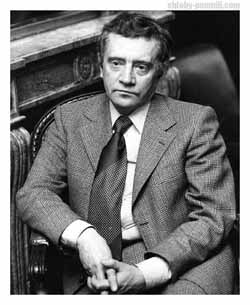
Vladimir Maximov (1930-1995)
*
A few days later Maximov was called before a medical commission, where psychiatric experts reclassified him as a Class III invalid (previously he was Class II). A report broadcast by Radio Liberty [2], stating that Maximov had been threatened with being put on trial, does not correspond to the facts.
Maximov’s latest work is the novel Quarantine [3].
*
KIEV
[3]
A meeting of the Presidium of the UkSSR Writers’ Union was held on 2 March 1972.
It considered the case of Ivan Dzyuba (Ukr. Dziuba) [4]. Those taking part in the discussion were M. Bazhan, S. Bandura, P. Voronko, U. Dmytrenko, P. Zahrebalny, Yu. Zbanatsky, D. Pavlychko, N. Rybak, V. Kozachenko, I. Le, L. Novychenko and V. Sobko.
*
On 3 March 1972, Literaturnaya Ukraina reported that Dziuba had been expelled from membership of the UkSSR Union of Writers
“for gross violation of the principles and requirements of the Constitution of the Union of Writers, and for the preparation and circulation of material of an anti-Soviet, anti-communist nature, which expressed nationalistic views and cast libellous aspersions on the Soviet system and on the nationalities policy of the Party and the Soviet government.”
This resolution was passed unanimously by the Presidium.
*
It is known that the subject under discussion at the meeting of the Presidium was Dziuba’s book Internationalism or Russification? which he wrote in 1965.
Two years ago there was a move to expel him from the UkSSR Writers’ Union for this book (CCE 11.15 [3]), but he was not actually expelled [5]. It can therefore be deduced that his expulsion on 2 March was connected with recent events: arrests in Ukraine and a search of Dziuba’s home (CCE 24.3).
At the end of January 1972, during a second search of Dziuba’s home, the complete works of V. I. Lenin, with notes in the margins and phrases underlined, were confiscated.
*
MOSCOW (4-7)
[4]
On 4 February 1972 A. T. Tsvetkov, editor-in-chief of the physics & mathematics department at Nauka (‘Science’) publishers, and his deputy V. B. Orlov — who is also deputy secretary of the department’s Party bureau — sent for Yury A. Shikhanovich [6].
They asked him a number of questions:
“Is it true that your home has been searched?” “What did they find?” “What are your beliefs?”
When Shikhanovich refused to answer this last question, he was told that his name would be removed from the title page of The Mathematics of Metamathematics. Written by Rasyovaya and Sikorsky, the book is due to be published this year and was edited by Shikhanovich.
In future, they added, the department would prefer not to work with him at all.
*
[5]
On 14 February 1972, on the recommendation of the Physics research journal’s editorial board, the physics & maths section of the Academic Board of the “All-Union Institute for Scientific & Technical Information” [VINITI] did not re-elect Andrei Tverdokhlebov for a further term as a junior research officer.
There were four votes in favour of his re-election, seven against, and three spoiled papers. The only reason for this action was Tverdokhlebov’s public activities: he is a member of the Committee for Human Rights. No adverse comments were made about his work.
*
[6]
Over a period of several months officers from Moscow’s Police Station 24 have repeatedly burst into the flat of Adele Osipova (née Naidenovich), wife of Vladimir Osipov, who is the editor of the samizdat journal Veche. [7]
They have summoned her to the police station, threatening to arrest her for “parasitism”. On one occasion, her identity document [passport] was taken away for three weeks.
On 1 November, standing beside the bed of Osipova’s semi-paralysed mother, two policemen and a man in plainclothes began threatening to arrest A. Osipova and her husband for producing the journal Veche. As a result, her mother suffered a number of strokes and eventually died.
On 10 January A. Osipova sent a letter of protest to KGB Chairman Andropov. Part of the letter reads [8]:
“… Fewer social evils are eliminated by your successes in the struggle against them, than are caused by the immorality of driving a woman out of her home to work …”
*
[7]
On 10 February Tatyana S. Khodorovich (CCE 19.8 [5] and CCE 24.1), a junior research officer at the All-Union Research Institute for Electro-Mechanics, applied to be released from her post on personal grounds. A few days later she asked for this application to be returned to her.
In reply she was told by A. A. Shuldov, head of the personnel department:
“… we know you’re a good worker. But we don’t want anybody working in our collective who supports anti-Sovietists. So we would have got rid of you before long in any case. That’s why we’re not giving you your application back. We are, incidentally, within our rights in doing this. …
“Of course, if you were to do your work and not engage in any other activities, it might be hoped that the Scientific and Technical Council [NTS, ed] would consider the possibility of your continued membership of our organisation … “
Later, when Khodorovich was no longer present, A. A. Shuldov said:
“… She submitted her application so as to pursue more strongly her shady affairs. Now the Scientific and Technical Council (NTS) [9] will subsidise her …”
==================================================
NOTES
- See also The Times, 6 March 1972 and the New York Times, 12 February, where the letter from four friends of Galich (CCE 23.9 [1]) is translated in full. See Grani (Frankfurt, No. 83, 1972), where his photograph and latest poems appear.
↩︎ - According to The Daily Telegraph (London, 29 February 1972) the KGB was now considering laying charges against Maximov.
↩︎ - On 31 May 1972, the Italian press (e.g., Il Messagero) reported on a press-conference given in Rome by Yury Glazov, who called on world public opinion to protest at the persecution of Maximov.
Glazov stated that 33 European writers and cultural figures (including Günter Grass, Federico Fellini, Iris Murdoch and Ignazio Silone) had sent a telegram to Brezhnev in Maximov’s defence. See also the Daily Telegraph, 13 June, and Russkaya mysl, 15 June.
↩︎ - On Dzyuba, see CCE 5.4 [5], CCE 7.13 [10], CCE 11.15 [3], CCE 12.9 [17], CCE 14.11 [20] and Name Index.
↩︎ - The second English edition of Ivan Dzyuba’s Internationalism or Russification? (London, 1970) has a long postscript on Dzyuba’s dealings with the UkSSR Writers Union.
↩︎ - On Shikhanovich, see CCE 2.1 [81], CCE 24.10 [4], CCE 25.2; CCE 27.2 [1] and Name Index.
↩︎ - See CCE Contents 16.1 for Veche and Osipov.
↩︎ - The full text of Osipova’s letter to Andropov was published in Russkaya mysl (Paris), 11 May 1972.
↩︎ - A provocative play on the acronym NTS, Russian title of the “People’s Labour Alliance”.
The NTS, commented the AI editors, “is one of the most vigorous anti-Soviet groups in the West”, adding that the organisation “effectively controls” the publications Possev and Grani.
Veteran dissidents and samizdat authors Levitin-Krasnov and Vladimir Bukovsky were more sceptical: see 5.2, “The NTS and the dissident movement”, Judgement in Moscow (2016), Chapter Five, “What ‘They’ Believed”.
↩︎
====================================
 A Chronicle of Current Events