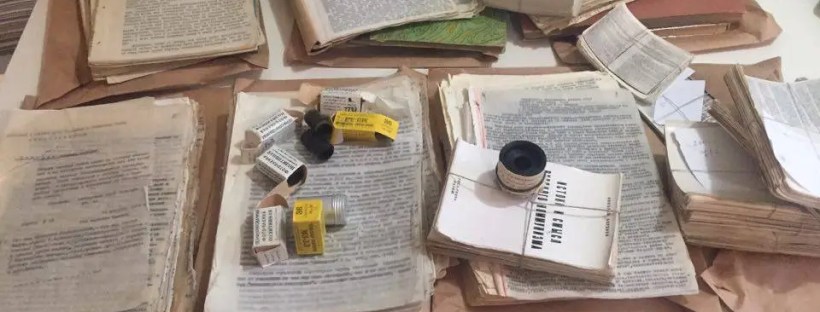
TEN ENTRIES
(1)
HERALD OF THE EXODUS, 1
A collection of documents
CONTENTS
Herald of the Exodus, No. 1:
- On the Eve of the Trials. Letters from relatives and friends of those facing trial in Leningrad (CCE 20.1), Riga (CCE 20.2), and Kishinyov (CCE 20.3);
- Visits by groups of Jews to USSR government bodies;
- The departure applications of Mikhail Kalik [1] and Vladimir Slepak;
- Letters, statements, telegrams and protests;
- Official documents: “Regulations on entering and leaving the USSR”; “On additions and alterations to Resolution No. 59804, USSR Council of People’s Commissars, 29 April 1942” [2]; and “On rates of State customs duty”.
*
(2)
Valery Chalidze
“A foreigner visited me”, May 1971
This booklet includes
- records of the searches of Chalidze’s room on 29 March and 7 April (CCE 19.11 [25]);
- an Open Letter from Academician Sakharov to Minister of Internal Affairs Shcholokov;
- the text of Chalidze’s conversations with a KGB investigator; and
- the text of his confrontation with the Belgian Hugo Sebreghts [3];
- a commentary to Bryantsev’s article “Under the mask of falsehood” (Izvestiya, 19 April 1971); and
- statements by Chalidze on these subjects sent to various bodies.
*
(3)
Mikhail Kalik
“To the Russian intelligentsia. To the editors of Izvestiya, Sovetskaya kultura and Literaturnaya gazeta“
An Open Letter in which the author, conscious of being a Jew and at the same time a Russian intellectual, reflects on the fortunes of “those who leave” and “those who remain” [4].

(2016 photo, Veronika Lyubarskaya)
*
(4)
SOCIAL ISSUES, 10
Social Issues, No. 10 (March-April 1971).
Compiled by Valery Chalidze
This issue contains
- Jerzy Savicki’s article, “A lawyer’s reflections on criticism”
- Alexander Volpin’s report to the Committee for Human Rights, “The International Pact on Civil and Political Rights (1966) and Soviet law”.
*
SAVICKI
The article by Polish lawyer Savicki (from Tribuna ludu, 1 January 1962) was written as a discussion of a draft of the Polish Criminal Code. He examines problems of the freedom of criticism in a socialist system. The Code, he says, lacks legal guarantees of the freedom to criticize, one of the reasons being the authorities’ fear of the consequences of criticism.
The complete elimination of criticism (it is true), as Savicki writes,
“is impossible to achieve, even in the conditions of a relationship between the regime and the citizen whereby public discussion of anything is absolutely prohibited, and, in the name of law and order (and to preserve the authority of the regime) citizens are instructed to channel all their critical observations only through their superiors, who ’know better how to extirpate evil’.”
The author points out that certain periods are characterised by “hostility towards any legal norms”. In order to prevent the growth of “the sphere left completely to the discretion of the authorities” he considers it essential to introduce legal norms guaranteeing freedom of criticism and limiting the risk from “incorrect” criticism.
Savicki’s specific proposals are: sanctions against the suppression of criticism, and verification of the true motives of the administration — when, for example, a critical person is dismissed in a way ostensibly within the framework of legality. “The security of the critic must be increased to the utmost”, Savicki urges.
*
VOLPIN
In his report Volpin sets out his thoughts on the extent to which the USSR satisfies the pre-conditions for ratification and observation of the International Covenant on Civil and Political Rights (1965).
Part of his report is devoted to the 1966 “Covenant on Economic, Social and Cultural Rights”. (Texts of the two Pacts were published in the 1968 Soviet book The Soviet Union and the United Nations Organisation: print-run 4,800 copies.) Volpin finds that the rights acknowledged in the first Covenant are already reflected in Soviet law and in the Conventions which the USSR has joined, with the sole exception of the “right to strike”.
When the second Covenant comes into force a UN Committee for Human Rights will be formed, empowered to examine violations of the rights acknowledged in the Covenant. The author presumes that the USSR, if it ratifies the Covenant, will be an active member of the Committee and will recognise, although such recognition is not obligatory, the competence of the Committee to examine complaints emanating from States (but not petitions from private individuals).
The rights acknowledged in the Covenant are also acknowledged by Soviet law.
*
The main issue, therefore, is the restriction of these rights in the USSR.
Is this compatible with the requirements of the Covenant?
Certain Articles of the Covenant, e.g.,
- (12.) “The right to enter and leave a country”;
- (18.) “The right to freedom of thought”;
- (19.) “The right to freedom of information”; and
- (22.) “The right to freedom of association”
might here be singled out for comparison with the situation, laws and practices existing in the USSR.
Although many rights acknowledged by the Covenant are poorly observed in the USSR, this is due not so much to our laws as to social institutions and traditions, which also determine the quality of legal proceedings.
Ratification of the Covenant cannot of itself alter this state of affairs. Although the author sees a need to make certain changes in the law, on the whole, he considers, the USSR is legally prepared for adherence to the Covenant.
*
THE LAST ITEM in this issue is a record of a meeting of Committee for Human Rights on 28 April 1971. It was then decided that the affiliation of the Committee as a group member to the “International League for the Rights of Man” [5] was acceptable.
*
(5)
VECHE, 2
Veche No. 2 (19 May 1971).
CONTENTS
1 — A statement by the editors of Veche [6]. The journal is not clandestine, the name and address of its chief editor, Vladimir N. Osipov, are provided. The editors reject the description of the journal as “extremely chauvinist”.
2 — Commentary by the editors on M.F. Antonov’s work (see 3, next).
3 — M. Antonov: “The teaching of the Slavophiles as the zenith of popular consciousness in Russia in the pre-Lenin period” (continued.)
The views of A.S. Khomyakov (1804-1860) are expounded: he was a conservative, not a reactionary. It must be remembered that he lived and worked more than a hundred years ago.
The 1917 October Revolution was a genuinely popular revolution—the “communal way of life” [obshchinny uklad], undistorted by “Western formalism” and so on. Orthodoxy is the “highest form” of Christianity and that which best corresponds to the spirit of the Russian people.
4 — “Shafts of Thought”. The remarks of an anonymous author on Russia and Orthodoxy.
5 — “On the forthcoming Assembly”.
A statement on the extra-ecclesiastical activities of Metropolitan Nikodim by Nikolai Gainov, minister of the Church of the Holy Trinity, and others. The authors protest at the resurrection of the Living Church [7] ideology [obnovlenchestvo], i.e., close collaboration with the State, in a new form.
6 — “General M.D. Skobelev (1843-1882) as soldier and statesman”. The author is not indicated.
7 — Anna Barkova: “Tatar melancholy” and other poems. A poet of the older generation; spent many years in the camps. She has not been published since 1920 [8].
8 — Mikhail Morozov: “Some remarks on contemporary literary developments”. An assessment is given of many contemporary writers, poets and critics:
“Our literature is vital, its mighty organism nourished by our thousand-year-old culture and by the particular spirituality peculiar to the Russian, and however hard it may be at times for it to breathe, nothing can interrupt its eternal, revivifying breath.”
9 — “Tom Thumb, or the bard of the ‘sexual revolution’.” A pasquinade by an anonymous author about Andrei Voznesensky.
10 — “Criticism and biography”:
“Mysticism before the tribunal of Shakhnovich” [9], edited by N. Bogdanov; “In the murk of foreign parts”, notes by Vladimir Osipov on a book [10] by former émigré B.N. Alexandrovsky; “Memoirs of a Meteor”, comments by A. Skuratov on the memoirs of A.F. Kerensky.
11 — “Our mail”:
a letter on the views of N.A. Berdyaev; a statement by an Orthodox priest on the moral state of the Russian nation; a letter from Leonid Rendel, a historian imprisoned from 1957-1967.
12 — The “Chronicle” section of Veche No. 2 reports the death of the poet N.M. Rubtsov [11]; Vladimir Maximov’s novel The Seven Days of Creation; the Naro-Fominsk affair (CCE 20.11 [15]); the dismissal of Yu. D. Ivanov as a senior lecturer at Moscow University for Slavophile sympathies expressed in the pages of the journal Molodaya gvardiya [12].
*
(6)
V. Lapin
“Discussing the issue of Capital Punishment”
A letter to the Presidium of the USSR Supreme Soviet, dated 18 May 1971 (CCE 17.13 [4]: Lapin, “On the abolition of capital punishment” (full text in Vestnik RSKLD 99, 1971).
This continuation of the correspondence with the USSR Supreme Soviet Presidium was provoked by a reply from Sedugin, deputy head of the Presidium’s Legal Department. “[T]he proposal to abolish capital punishment”, wrote P. Sedugin, “was discussed and rejected during the preparation [late 1950’s] of the Fundamentals of the Criminal Law of the USSR and the Union Republics.”
*
(7)
Vasily Nikitenkov
Open Letter of 12 May 1971 [13]
Doctor Vasily Nikolayevich NIKITENKOV, together with his wife, was placed in a psychiatric hospital after an attempt to enter the US embassy on 16 March (CCE 19.11, [1]). Here he appeals to all honourable people to help his family.
*
(8)
Yury Glazov [14]
“To Israel …” (26 May 1971)
An essay on the newly arisen Jewish problem with a brief excursion into history.
*
(9)
‘K. Burzhuademov‘
“Anti-Galbraith”
The author demonstrates the superiority of a free-market economy over a feudal-directive economy.
Polemicising with Galbraith, author of the book The New Industrial Society, Burzhuademov [15] denies that any large-scale enterprise can be progressive. There are interesting parallels between modern production and the world of nature, between interfering with the economic structure and upsetting the biological equilibrium.
The author uses the word “socialism” in an unusual sense: by socialism he understands nationalisation, the consolidation of production in the hands of the State.
The author protests that the bourgeois ideals of hard work, thrift and prosperity are held in haughty and feudal [feodalno-barsky] contempt. Appendices contain an exposition of the author’s views on various subjects: communist ideology; the prospects of the democratic movement; and a response to Andrei Amalrik’s Will the Soviet Union Survive until 1984?
*
(10)
V. Voskresensky
“For my friends”
A collection of poems by the young Moscow poet, a member of SMOG [16], who was associated with the unofficial publications Sphinx, The Russian Word and so on.
He died tragically in January 1970.
===========================================
NOTES
- M.N. Kalik (1927-2017) was a film-maker, see “Banned Films” (CCE 19.9 [5, 16]).
↩︎ - For the text of this Resolution, see Vedomosti Verkhovnogo Soveta SSSR, No. 4, 1942 (pp. 74-79).
↩︎ - For details of Chalidze’s encounter with Sebreghts, see Possev 1971, Nos 4 (p. 8) and 5 (pp. 22-24).
↩︎ - Kalik’s letter, dated 5 May, appeared in the Swiss National Zeitung newspaper (Basel, date unknown).
↩︎ - Founded in 1942 in New York. Changed its title in 1976 to the International League for Human Rights (cf. CCE ///).
↩︎ - The text of the statement by Veche editors was published in Possev, No. 5 1971 (p. 8).
↩︎ - The “Living Church” emerged in the 1920s and lasted until the late 1940s as a challenge to Orthodoxy in Russia. More formally it was known as ‘Renovationism’.
↩︎ - On Barkova, see obituary CCE 40.15 [31].
↩︎ - Professor M.I. Shakhnovich was a Soviet specialist on the history of religion and atheism. He was author of a number of works attacking mysticism, parapsychology and so on.
↩︎ - B.F. Alexandrovsky, My Experiences in Foreign Parts: Reminiscences and Reflections of a former émigré (Mysl publishing house: Moscow, 1969). Reviewed in Molodaya gvardiya, issue 3, 1970 (pp. 292-296).
↩︎ - Rubtsov was 35. See also notices of his death in Literaturnaya Rossiya, 22 January 1971.
↩︎ - See articles by Ivanov in Nos. 2, 6 and 12 of Molodaya gvardiya (1969).
↩︎ - Extracts from Nikitenkov’s letter were published in The Washington Post and The Daily Telegraph, 22 May 1971. The text was written in the Central Moscow Regional Clinical Psychiatric Hospital on “8th March” Street.
↩︎ - Glazov was a well-known linguist who signed several protest letters.
↩︎ - “K. Bourgeoisdemov” was subsequently revealed to be the pen name of Poiski editor Victor Sokirko (CCE 58.7-2).
↩︎ - SMOG was a loosely-knit group of young writers which flourished in the 1960s. The group’s title is made up of the initials of the Russian words for “boldness, thought, image, depth”.
See Voskresensky’s poems in Grani, No. 66, 1967 (pp. 20-21).
↩︎
===============================
 A Chronicle of Current Events