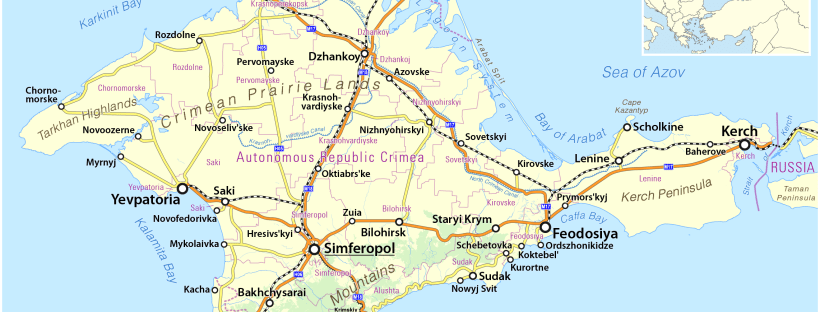
Simferopol
On 18 November 150 Crimean Tatars assembled at the Regional Soviet executive committee building to ask the committee chairman for permission to register as residents and obtain employment.
The chairman refused to see them and the police detained two persons [correction CCE 39.14]: Mustafa Osmanov, demobilized in 1972, has been living since then at the Shalfein State Farm without a residence permit, and Servet Mustafayev from the village of Belaya Skala. The rest were taken to the Regional Ministry of Internal Affairs (MVD) headquarters.
There Superintendent Gaidamak interviewed four people and on various pretexts refused to grant them residence permits. The Tatars dispersed only after the two who had been detained were released.
*
On 22 November 1975, Medat Kurtvanov and Mamedi Chobanov were taken off the Simferopol-Kharkov train at Simferopol railway station.
Letters in defence of Mustafa Dzhemilev [1] were confiscated from Chobanov: these contained 700 signatures and were addressed to the CPSU Central Committee and the Committee of Human Rights. Two days later Chobanov was taken back to his home village of Zhuravki by KGB officials; a search was then carried out. Nothing was confiscated during the search, which was conducted by Ilinov, an official from the Regional MVD and by two policemen and two KGB men.
One of the KGB men, who called himself Ivan Timofeyevich, said:
“If you go on behaving like this there might be a repetition of what happened in 1944.”
*
Adzhimelek Mustafayeva, who was arrested in September 1975 (CCE 37.6), has been sentenced to 18 months banishment from the Crimea.
*
“The Crimean Hills are in Danger”
In September 1975 Refat Khalilov, who in recent years lived in southern Ukraine (Novoalekseyevka, Kherson Region), bought a house in the Bakhchisarai district of Crimea, in his home village of Gavr. Today it is called Plotinnoye.
On 29 September 1975, he set off in a truck, with his household effects; his wife, children (16 and 14) and aunt travelled in a car lent by a friend. The truck was stopped and turned back at Chongar, the first traffic-police post in the Crimea.
The car in which Khalilov’s family was travelling was not stopped till after Simferopol, in the Priyatnoye Svidaniye [‘Pleasant Meeting’] settlement. Here they were met by policemen, a plain-clothes man and a number of vigilantes (druzhinniki). The driver’s documents were confiscated and the car was escorted to the Crimean border, where the documents were returned.
*
Over the next few days the roads leading to Plotinnoye village were patrolled by police units.
On 30 September (or 1 October) the leaders of the State Farm and local Party activists were summoned to the Golubenkoye village soviet. There two KGB officials explained to them that, although all nations are equal in our country, the Crimean Tatars could not be allowed to return to these villages. On the other hand, after the European Conference, which concluded in August 1975 [2], they could not be deported either.
For this reason they must take every measure to ensure that Crimean Tatars did not buy houses in the Crimea.
On 9 October 1975 Khalilov’s family (without him) nevertheless arrived at their house.
A local policeman soon turned up and examined their documents. About two hours later, two cars drove up to the house, containing a police colonel and captain, with the chairman of the village soviet and a group of vigilantes. A bus belonging to the State Farm also arrived. The colonel ordered all Khalilov’s family to get into the bus immediately.
Nazife Osmanova, Khalilov’s aunt, showed him a letter announcing her husband’s death at the front, while defending Sebastopol. She asked to be allowed to spend just one day in her homeland, which she had not seen since 1944.
The former owners of the house were shocked by the cruelty of the police. “You’re driving people out just like the Fascists,” said the former owner’s 18-year-old son.
The driver wanted to refuse his services, as it was time to take the children home from the infant-school. “The children will get home by themselves,” said the police colonel: “the main job now is to get these people out of the Crimea.”
With two vigilantes as an escort, the family was driven back to Novoalekseyevka in Ukraine.
*
Appeal by Crimean Tatar Women (August 1975)
On the occasion of International Women’s Year [3], the upcoming 25th CPSU Congress (24 February-5 March 1976), and the 30th anniversary of Victory in the Patriotic War (1941-1945), Crimean Tatars have sent an appeal to the Party and the Soviet government.
The text names dozens of Crimean-Tatar women who fought heroically at the front, in partisan units and as members of the underground. Many perished. The tragedy of the nation’s deportation in May 1944 and its destruction in exile is described. For example, Periya Dzhumaniyaziya, whose nine sons died at the front, herself died from hunger in exile.
The appeal calls for the return of the Crimean Tatars to their homeland. It was signed by about one thousand people.
*
Newsletter No. 115 (207)
of the Representatives of the Crimean Tatar Nation
Volume 207 contains information about the Crimean-Tatar People sent to the 25th CPSU Congress.
It consists of:
(a) A petition “Demands of the Crimean-Tatar Nation” (20,000 signatures);
(b) data on the History of the Crimean Tatars;
(c) Statistics on the nation’s population from 1944 to 1974, compiled from independent censuses and inquiries.
Before 1944 there were 560,000 Crimean Tatars.
- 57,000 perished in the war against German fascism;
- 80,000 were serving in the regular army in May 1944;
- the remaining 420,000 people were deported from the Crimea;
- In its first years of exile the nation lost 46 % of those deported, i.e. 193,000 people.
Today there are 833,000 Crimean Tatars;
(d) statistics on the material losses suffered by the nation as a result of the deportation (in total they amount to almost three million New Roubles), and the destruction of cultural treasures, cemeteries and other national and religious treasures;
(e) photocopies of various documents submitted to the CPSU Central Committee between 1964 and 1974. (This volume of materials was also sent to the United Nations and to the Italian and Rumanian Communist Parties, Chronicle).
In addition, the following letters have been sent to the CPSU Central Committee:
- from veterans of the Second World War (331 signatures);
- describing the activities of the Crimean authorities against Crimean Tatars (598 signatures);
- 160 individual letters.
On 23 November 1975, it is reported, a set of the above-mentioned documents was confiscated by KGB officials and USSR MVD officials from left-luggage lockers at the Kazan Rail Station in Moscow.
*
Mustafa Khalilov, a representative of the Crimean Tatars, set off for Moscow but was taken off the plane on 20 November 1975 while it was still in Tashkent.
*
It is reported that on 23 November 1975 a monument to the pilot Ametkhan Sultan, twice decorated Hero of the Soviet Union, was ceremonially unveiled at the Novodevichy Cemetery in Moscow
The monument was built with funds collected by Crimean Tatars and funds donated by the Aviation Institute where Ametkhan Sultan worked as an experimental pilot prior to his death in the Patriotic War (1941-1945).
*
The Newsletter is signed by the following (all except the last are from the Uzbek SSR):
Mukhsim Osmanov, Zore Memetova, Nuri Kayaliev and Server Matrosov (Ferghana Region);
Amet Abduramanov, Mustafa Khalilov, Alpaz Seidametov, Umer Ilyasov and Ibraim Ibraimov (Tashkent Region);
Akim Abdureshitov and Aishe Veliullayeva (Andizhan Region);
Shevkhi Mukhteremov and Kadyr Ametov (Samarkand Region);
and Dilyara Dadoi (from the Crimean Region).
======================================
NOTES
- Awaiting trial in Omsk (west Siberia), Mustafa Dzhemilev was engaged in a lengthy hunger-strike (CCE 38.14) in protest against his arrest and prosecution.
↩︎ - The “European Conference” refers to the CSCE Conference, held from 1973 to 1975, which concluded with the signing of the Helsinki Accords or Final Act.
↩︎ - 1975 was declared International Women’s Year by the United Nations.
↩︎
=========================
 A Chronicle of Current Events