<< No 30 : 31 December 1973 >>
*
KALANTA ANNIVERSARY
On 14 May 1973, the first anniversary of Romas Kalanta’s self-immolation (CCE 26.11, CCE 27.3), extra detachments of police armed with rubber truncheons and equipped with portable two-way radios patrolled Kaunas.
*
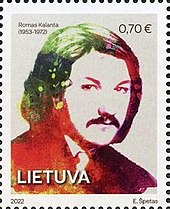
Romas KALANTA (1953-1972)
Memorial stamp 2022
*
Pupils and officials of various institutions were also delegated to help maintain order.
There were many people on Freedom Avenue, where Kalanta burned himself to death, and the police did not allow them to stop moving. Various pretexts were used to see to it that pupils from many schools were taken out of town for a few days. In some schools “masses” lasted from 8 am.
Some people attempted to place flowers on Kalanta’s grave or the site of his self-immolation. They were all detained. The number of detainees is not known.
*
Chronicle of the Lithuanian Catholic Church
[1] Issue 7, August 1973
The seventh issue of The Chronicle of the Lithuanian Catholic Church (LCC Chronicle) was published in August 1973.
It reports about searches and interrogations concerning the collection of signatures on statements
- (a) about religious literature sent to The Committee for Religious Affairs, and
- (b) about discrimination against religious schoolchildren addressed to the Lithuanian SSR Ministry of Enlightenment [Education] (CCE 29.9).
*
On 6 April 1973, sheets of paper containing 40 signatures to statements were taken from the home of Julijus Rudys (Mieziskiai, Panevezys district) after a house-search had been threatened.
Rudys’ wife was summoned for interrogation several times. Many of those who had signed the statements were interrogated, as were Rudys’ daughter (an 11th-year pupil) and even Rudys’ 11-year old son. On 23 May J. Vilutis, Lithuanian Procuracy Investigator for Especially Important Cases, conducted a search of Rudys home.
In the course of various interrogations the investigators threatened to deprive his wife of her parental rights and expel her daughter from school, or get the girl given a bad character reference.
The investigation tried to obtain testimony about lines of communication to priests, about people who had signed the statements, and about those who had collected the signatures.
*
On 24 May 1973 the home of Mrs. E. Svireliene (Panevezys) was searched and also her place of work.
Next day another search took place at the sanatorium in Druskinikai where she was on holiday. She and her daughter were both interrogated. The investigator threatened to have them dismissed from their jobs and to institute criminal proceedings
*
GRINCEVICIUTE
Miss V. Grinceviciute (Kaunas) was searched three times in late March and in April 1973.
The search parties were looking for the text of a statement which, the investigation asserted, she had shown to several people. No procurator’s warrant was presented for the searches.
On 11 May Grinceviciute was searched at home and at work, on this occasion with the sanction of the procurator. J. Vilutis supervised the searches. Grinceviciute was interrogated repeatedly about the statements and also about numerous people. During the interrogations she was threatened with criminal proceedings.
At all the searches mentioned, religious literature was confiscated.
*
On 13 May 1973, reports LCC Chronicle 7, a group of students from Vilnius University placed flowers at the foot of the statue of the Lithuanian Grand Duke Vytautas (Perloja, Varena district).
Three students (Eugenijus Banys, Remigijus Kajeckas and Pranas Grigas) were searched, interrogated and later expelled from the university for “a flagrant breach of discipline”. Pro-rector of the University, Sudavicius, regarded their placing of flowers as a disguised commemoration of the anniversary of Romas Kalanta’s self-immolation.
The Central Committee of the Communist Party of Lithuania, to which the injured parties appealed, approved their expulsion.
Placing flowers beneath the statue of a “feudal lord and usurper” was considered incompatible with the principles and patriotism of Soviet man.
*
On 8 May 1973, K. Tumenas, newly-appointed head of the Committee on Religious Affairs, made the acquaintance of bishops and other influential figures of the Church (LCC Chronicle 7).
After offering them assistance with the publication of church literature, Tumenas singled out several “negative aspects” of the life of the Lithuanian Catholic Church. He termed the Chronicle of the Lithuanian Catholic Church a slanderous publication (No 5 was the issue he held up as an example), designed for sending abroad, and said someone would have to answer for it.
Another negative aspect he cited was the collection of signatures on statements by believers.
*
LCC Chronicle 7 has published a statement by 540 believers sent to the Presidium of the Lithuanian SSR Supreme Soviet in August 1973.
The authors attribute the decline of moral standards to the forcible inculcation of atheism. They ask the Presidium of the Supreme Soviet:
- to put an end to discrimination against believers, including schoolchildren;
- to permit unrestricted publication of religious literature and the establishment of social organizations for religious people; and
- not to limit the number of candidates for the ministry entering theological seminaries.
In a note signed “Representatives of the Catholics of Lithuania” it is explained that the original copy of the statement, with the signatures, will not be handed in to the Supreme Soviet, as people who sign such statements are persecuted by the KGB.
*
LCC Chronicle 7 also reported the following:
- intervention by the authorities in the affairs of the Church in Silale, Alunta, Veisiejai and Ratnycia;
- violation of parental rights and discrimination against religious schoolchildren in Ceikiniai parish;
- and persecution of the priests A. Keina (CCE 23.8 [4]), A. Liesis and G. Dovydaitis.
*
[2] Issue 8, December 1973
LCC Chronicle 8 appeared in December 1973.
It reported mass searches on 20 November 1973 in Lithuania linked to “Case 345” (the preparation of religious literature and literature which “defames the Soviet system”).
*
CASE 345
One of the chief objectives of the searches, it seems, was to track down the publishers of the Chronicle of the Lithuanian Catholic Church.
The homes of the following people were searched:
- Father B. Babrauskas (vicar of Smilgiai parish),
- Father J. Buliauskas (Krincinas),
- Miss Monika Gavenaite (Kaunas) [1],
- Kacergis (Kapsukas),
- Father A. Keina (vicar of Valkininkai parish),
- J. Kapustas (Semeliskes),
- Miss S. Kriauciunaite (Panevezys),
- Father J. Lauriunas (vicar of Kabeliai parish),
- V. Lapienis (Vilnius),
- Mrs T. Maciukiene (Kaunas),
- Miss K. Misiunaite (Kaunas),
- Miss J. Mickeliunaite,
- Miss O. Norkute (both Panevezys),
- Father Vladimir Prokopiv (Vilnius) [2],
- Miss L. Razminaite (Panevezys),
- Miss Z. Rasminaite (Siauliai),
- A. Ratkevicius (Pasvalys),
- A. Reskevicius (Kaunas),
- Mrs R. Strasiskiene (Virsuzpiris village),
- S. Skripkus (Siauliai),
- Miss O. Tomulinaite (Kaunas),
- J. Tarnauskas (Kaunas),
- J. Urbonas (Kaunas),
- Z. Urbon (Vilnius),
- Miss N. Cincinaite (Kaunas),
- A. Jasenas (Vevys),
- V. Jaugelis (Kaunas) [3] and
- A. Jaugelis (Kaunas).
Petras Plumpa and Povilas Petronis were arrested after being searched.
Jonas Stasaitis (Salininkai, Vilnius district) was arrested on 4 December at an interrogation by the KGB. He, too, had been searched on 20 November. LCC Chronicle 8 assumes there were many other searches about which there is still no information.
Religious literature, including pre-war publications and typewriters were confiscated during the searches and, in some cases, issues of LCC Chronicle.
Copies of the Holy Scriptures (Soviet edition, 1972) were taken from Miss Cincinaite and Mrs Maciukiene.
A home-made printing press and matrices for a prayer book were taken from Z. Urbon; wax printing material was taken from V. Jaugelis, and a book-binding machine from A. Jasenas.
Almost all of the people searched were interrogated (many of them repeatedly) about their acquaintances and the sources of the literature confiscated. Some of those interrogated were threatened with arrest.
*
The following have been dismissed from their jobs: Miss B. Papkeviciute, Cand. Sc. (pedagogy), Miss D. Gailiusyte, a teacher, and Miss E. Suliauskaite, senior laboratory assistant at Vilnius University.
All three were accused of belonging to a Catholic order of nuns.
*
LCC Chronicle 8 reports that on 19 May 1973, according to an ancient tradition, young believers from the town of Siauliai carried a cross to the Meskuiciai burial mound, known as “The Hill of Crosses”.
For doing this, M. Jurevicius, V. Ivanovas and Z. Mistautas were interrogated several times. Subsequently Ivanovas was expelled from music school.
*
LCC Chronicle 8 also carries reports on the persecution of the priests P. Nykstus, A. Laurinavicius, S. Zvynis and S. Galvydis [4], and other materials on discrimination against believers.
*
The following notice appeared in the newspaper Kauno Tiesa on 24 December 1973:
“In the Procuracy of the Lithuanian SSR
“Investigative agencies of the republic have arrested and instituted criminal proceedings against: Petras Pliuira Plumpa, who was living on forged papers; Povilas Petronis, who does not have a permanent residence or occupation; and Jonas Stasaitis, a resident of Salininkai in the Vilnius district.
“Violating the norms established by law, these people prepared and duplicated works of a reactionary nature which they circulated among the population of the republic.
“For these purposes, they used illegally procured duplicating equipment.
The investigation continues.”
*
On 20 November KGB agents repeatedly resorted to crude threats while interrogating A. Raskinis, Cand. Sc. (Technology) and an associate of the Kaunas Research Institute for the Physico-Technological Problems of Energetics//.
They not only threatened to institute criminal proceedings against him for his refusal to give testimony, but also: to have him dismissed from his job, arrested, and given a long prison term. They informed him that unless he testified, his wife, too, might lose her job.
It appears that the first steps to implement this threat have already been taken. At the Kaunas branch of Vilnius University, where Raskinis’ wife, D. Raskiniene, Cand. Sc. (physics & mathematics), teaches mathematics, an open Party meeting was held.
Here Raskiniene’s dismissal was discussed in the light of the fact that she openly practises her religion and therefore cannot educate students in the correct way.
No final decision was reached at the meeting.
=========================================
NOTES
- Monica Gavenaite was dismissed from her job as publishers’ editor soon after this search, on suspicion of being a nun (CCE 32.10).
↩︎ - For texts of statements made to the authorities by Father Vladimir Prokopiv, see LCC Chronicle 9 & 11.
↩︎ - Virgilijus Jaugelis was arrested on 9 April 1974 (CCE 32.10).
↩︎ - See the appeal by Lithuanian priests for Jaugelis and two others in A Chronicle of Human Right in the USSR (CHR, New York), No. 11, 1974.
↩︎
=============================
 A Chronicle of Current Events