On 5 April 1981, Felix Serebrov wrote a statement.
Being hostile towards the Soviet authorities, it said, he had engaged in the composition and circulation of documents and materials which were used by the Western media to damage the international prestige of the USSR.
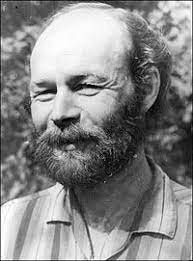
Felix Serebrov (1930-2015)
On 19 May 1981, Serebrov wrote another statement. This time he condemned his own activities and promised not to engage in anything similar in the future.
On 21 May the charge against Serebrov was reclassified, from Article 190-1 to Article 70 (RSFSR Criminal Code).
*
THE TRIAL
On 20 and 21 July 1981 the Moscow City Court, presided over by Judge V.V. Bogdanov [1], examined the case against Working Commission member Felix Arkadevich SEREBROV (b. 1930).
Arrested on 8 January 1981 (cce 61.2-2), Serebrov was later charged under Article 70 (RSFSR Criminal Code) [2].
The prosecutor was the same A.A. Golovin.
Serebrov rejected the lawyer appointed by the court. He also turned down the services of E.A. Reznikova after he and she had concluded their study of the case file (cce 62.4).
*
On the morning of 20 July Serebrov’s wife went to the City Court where the case was due to be examined. There she was told that the trial would take place at the Lyublino district people’s court.
She went there, only to learn that the trial was taking place in the Babushkino district people’s court (where Alexander Lavut stood trial, late in December 1980, CCE 60.2).
Apart from the specially invited audience only Serebrov’s wife and stepdaughter were admitted into the courtroom.
*
Serebrov was charged with the composition, signing and circulation of:
- Working Commission Information Bulletins Nos. 12-22 (together with Vyacheslav Bakhmin, Alexander Podrabinek, Leonard Ternovsky and Irina Grivnina);
- The letters “A Word from an Islander in the Gulag Archipelago” (1978) and (with Nekipelov) “A Democracy Faculty. On foreign radio broadcasts in Russian: advice and suggestions”, (CCE 54.24);
- Individual letters in defence of Gleb Yakunin and Leonard Ternovsky;
- Collective letters in defence of Tatyana Velikanova, Alexander Lavut and Tatyana Osipova;
- The appeal “To People Living on Earth”;
- A statement in connection with a search on 10 April 1980 (CCE 56.4);
- Moscow Helsinki Group Documents No. 138 and No. 146 (CCE 60.24-2);
- “An Open Letter instead of an Autobiography” (cce 61.2-2), published after Serebrov’s arrest.
Serebrov was charged with activities that began in the autumn of 1978 after his release from his previous term in the camps (CCE 51.9-2).
*
Day One
After the reading of the indictment, Serebrov‘s statement (5 April 1981) was read out. The Judge asked Serebrov whether he was pleading guilty or not.
Serebrov acknowledged the authorship of all the documents incriminating him, he said, but he denied an intention of undermining or weakening the Soviet political and social system.
One sentence in the indictment was not his, said Serebrov: it had been dictated to him by the investigator. He “hadn’t previously supposed”, he said, “that his materials could be used to damage the prestige of the USSR”. Serebrov also confirmed that he had been engaged in the distribution of the documents incriminating him.
He testified that he had appeared at press conferences “in a number of private flats” in front of Western correspondents. In response to the court’s attempts to obtain details about this testimony Serebrov named Yury Yarym-Agayev (who emigrated the previous year, CCE 57.18).
Vsevolod Kuvakin was called and questioned as a witness. Kuvakin confirmed that two copies of the Information Bulletin (Nos. 6 & 11) had been confiscated from his home during a search, but he did not remember where he’d got them from.
Six doctors from various psychiatric hospitals were questioned. They discussed the good conditions created for sick people: the people held in hospitals really are sick, they said.
*
A TASS report dated 20 July 1981 ran as follows:
“’I condemn my harmful activities directed against the Soviet authorities’, announced the defendant, Felix Serebrov.’ I repent that I have systematically conducted anti-Soviet agitation and propaganda by circulating documents containing slanderous fabrications defaming the Soviet political and social system’.
Serebrov fully admitted his guilt in respect of the charges against him.”
*
Day Two
Answering the court’s questions, Serebrov pleaded guilty to composing and circulating anti-Soviet documents; he insisted, however, that he had had no intention of undermining the Soviet system: he had not circulated deliberate fabrications. He admitted partial guilt.
Serebrov also said that during the investigation he had discovered many mistakes in the Information Bulletins. However, he insisted that there was nothing premeditated about these mistakes.
Serebrov named a few foreign correspondents to whom he had given his material at press conferences.
Serebrov expressed his repentance for engaging in anti-Soviet activities and stated that he did not intend to engage in them in the future. The procurator asked for a sentence of four years in the camps and five years of exile for Serebrov.
Serebrov’s defence speech emphasized that there was no anti-Soviet intent in his activities and that the material incriminating him, in spite of a large number of mistakes, did not contain any deliberate lies. He also dwelt on the fact that the court had not discussed the matter of whether the hospitalized patients really constituted a social danger, but had merely established the fact that they were mentally ill. He had not been able to obtain an answer to this question from the doctors questioned as witnesses during the trial. The Working Commission, when talking of compulsory hospitalization for political reasons, had not asserted that those hospitalized were healthy.
Serebrov declined to make a final speech.
(That day Serebrov looked much worse than the previous day: for two hours before the trial he had been confined in a prison van.)
*
SENTENCE
The sentence was four years of strict-regime camp and five years of exile.
The judgment included references to Irina Grivnina’s testimony, and to the fact that Serebrov was a most active member of the Working Commission: he had played a leading role in editing the Information Bulletins, especially the most recent issues.
(Grivnina‘s testimony was not read out in court and was not even mentioned during the course of the trial.)
=====================================
NOTES
- Vladimir Bogdanov of the Moscow City Court was one of a handful of judges who specialised in dissident cases: Dyshel in Ukraine; Isakova in Leningrad; Lubentsova in Moscow: see Name Index.
Bogdanov presided over half a dozen and more trials in Moscow between 1970 and 1981: Natalya Gorbanevskaya (1970), Olga Joffe (1970); Anatoly Krasnov-Levitin (1971), Dmitry Mikheyev & Francois de Perregaux (1971); Petya Starchik (1972), Kronid Lyubarsky (1972); Andrei Tverdokhlebov (1976) and Felix Serebrov (1981).
↩︎ - On Serebrov, see CCE 47.1; CCE 48.10-2, CCE 55.10-1 [4] and Name Index.
↩︎
====================================
 A Chronicle of Current Events