around the USSR …
[1]
LENINGRAD
In Leningrad a military tribunal of the Baltic Military District has tried a number of military engineers (CCE 10.5 and CCE 11.5). The charges, under Article 70 (RSFSR Criminal Code), concerned the formation of the “Union of Struggle for Political Rights”.
The court sentenced Gennady Gavrilov to six years in strict-regime camps and Alexei Kosyrev to two years. Paramonov was judged to be of unsound mind and placed in the Special Psychiatric Hospital in Chernyakhovsk (Kaliningrad Region).
*
[2]
ESTONIA
The Estonian SSR Supreme Court has sentenced: Raivo Lapp (b. 1947), a laboratory assistant at Tartu University, to five years’ imprisonment; Andres Vosu (b. 1946), a Tartu taxi-driver, to 3 ½ years; Enn Paulus (b. 1947), a Tartu garage mechanic, to 2 ½ years; and Sven Tamm (b. 1940), to a suspended sentence of three years.
The trial took place from 9 to 15 June 1970; the Judge was Uuskuela and the Procurator, Kesler.
The investigation was carried out by Majors Sokolov and Silkin, and by Lieutenant Kruuslak.
The accused were arrested on 11 December 1969 and charged with possessing weapons and with forming an organisation which (according to the verdict) “would have taken up arms against Soviet regime in the event of a conflict between Estonia and the USSR.”
The convicted men have arrived in the Mordovian camps. Their addresses are: R. Lapp, penal institution ZhKh 385/17A; A. Vosu and S. Paulus, penal institution ZhKh 385/17.
*
[3]
KARAVANSKY
On 30 June 1970 the appeal in the case of Svyatoslav I. Karavansky (CCE 13.7) was heard by the RSFSR Supreme Court.
S. I. Karavansky was tried in Vladimir Prison on a charge under Article 70 (Anti-Soviet Agitation & Propaganda). He was charged with the preparation and circulation of manuscripts written in invisible ink.
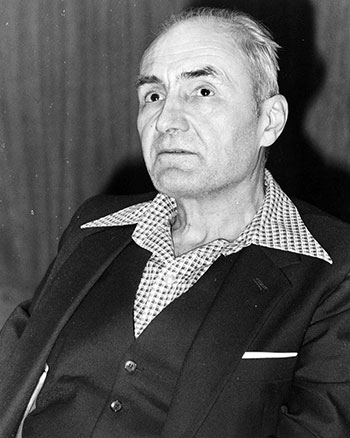
Svyatoslav Karavansky (1920-2016)
The sentence of the lower court, five years’ imprisonment, was left unchanged and defence counsel’s complaints went unheeded.
Defence counsel had asked for the sentence to be quashed, on the grounds that there were no case to answer, for the following reasons:
- the invisible writing was written in capital letters, and the accused refused to accept the findings of a graphological examination which maintained that the handwriting was his;
- the fluid used as invisible ink was a medicine which a prisoner could not possibly have had at his disposal;
- the manuscripts submitted in evidence were so numerous that a prisoner would have needed a lot of time to produce them. Such activity could not have passed unnoticed by his constantly-present cell-mates and the warders supervising him, yet none of the witnesses testified to ever having seen Karavansky at work;
- in order to read the invisible writing it was necessary to use chemicals or to heat it to a high temperature, whereupon the text became visible.
Now the KGB had a device which enabled it to read invisible writing without developing it. The invisible writing produced in court was undeveloped, which implied that it had been read only by the KGB or the inquiry agencies. In this way the possibility that Karavansky had either circulated or prepared the manuscripts was excluded.
*
[4]
APPEAL
In 31 August 1970 the appeal in the Gorky case (CCE 11.15 [13]) of Sergei Ponomaryov, Mikhail Kapranov, Vladimir Zhiltsov and Vladlen Pavlenkov (CCE 12.4, CCE 13.3) was heard in Moscow by the Supreme Court. They had all been convicted of offences under Articles 70 & 72 (RSFSR Criminal Code).
The RSFSR Supreme Court left the sentences unchanged: Pavlenkov and Kapranov were sentenced to seven years’ imprisonment in strict-regime camps; Ponomaryov was sentenced to five years and Zhiltsov, to four years’ imprisonment.
========================================
 A Chronicle of Current Events