TWENTY-SEVEN ITEMS
[1]
On 5 December 1969 the traditional silent demonstration (CCE 6.9 [3]) was held on Pushkin Square.
The first of these demonstrations was in support of Yuly Daniel and Andrei Sinyavsky, and took place on 5 December 1966 [1], under the slogan “Respect the Constitution”.
This time about fifty people went out on to Pushkin Square to honour the memory of their comrades in camps, prisons and exile. At six o’clock in the evening the demonstrators, surrounded by a crowd of plainclothes security guards, bared their heads.
*
[2]
STALIN
On 21 December 1969, the 90th anniversary of Stalin’s birth, a group of people well known for their uncompromising attitude towards Stalinism went out on to Red Square.
Among them were Zinaida Mikhailovna GRIGORENKO, Pyotr Yakir and Anatoly Jakobson. Their aim was to shame the Stalinists, who, it was rumoured, were intending to go to Red Square that day to express their love for the murderer of millions.
*
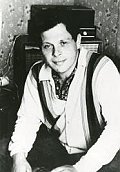
Anatoly Jakobson (1935-1978)
According to some reports, the Stalinists did indeed stage something akin to a demonstration.
Moving towards the Lenin Mausoleum in the general flow of people, they turned aside towards the Kremlin wall and placed panegyric obituaries and flowers on Stalin’s grave (CCE 14.6). This half-concealed demonstration was noticed by few people apart from the security guards.
*
One anti-Stalinist who was on Red Square describes the occasion thus:
“Even before we got to Red Square we were warned by KGB men, who were following our every footstep: ‘Remember, no placards’. We came out on to Red Square from the Historical Museum side. The square was cordoned off on all sides with movable metal barriers and ringed with troops and policemen. A narrow gap had been left open for the queue of people going to the mausoleum. The cordons were swarming with plainclothes security men. A police colonel (MVD) turned to us and said: ‘Clear off, there’s nothing for you to do here, you won’t succeed in carrying out your schemes.’
“We passed the GUM Store [2] and, keeping together, came up to the cordon from the direction of the Place of Proclamation [3], in front of St Basil’s Cathedral]. We stood there, hemmed in by a crowd of KGB men. Convinced that in these conditions any unauthorized activity was inconceivable, and hence that any open demonstration by the Stalinists would be impossible, we decided to leave.
“At that moment one of our comrades dropped on the ground a portrait of Stalin with a black cross painted over it. (We had decided to hold this portrait up above our heads as a protest, should the Stalinists appear on Red Square, as expected, with pictures of their idol.) The dropped portrait fell by A. Jakobson‘s feet. Jakobson was instantly seized by KGB agents, bundled into a car — there were vehicles standing at the ready — and driven away.”
*
Jakobson was taken to Police Station 47.
He was released after six hours’ detention, having been searched and interviewed by an investigator with the rank of Major. Next day Yakobson was taken from his home by an agent of the criminal investigation department to Police Station 80. There it was suggested he sign a fantastic record, compiled who knows when, attributing to him actions he had never committed.
Jakobson did not sign the ‘record’. He was searched and then sent to Police Station 6, where, after another search, he was again put in a pre-trial detention cell, this time for the night.
On 23 December 1969, Jakobson was tried ‘for petty hooliganism’ by the Lenin district people’s court, and fined on a charge of violating public order.
*
[3]
Ukrainian critic and publicist, Ivan Dzyuba, has been expelled from the Writers’ Union.
His expulsion passed without a hitch at a meeting of the Ukrainian writers’ section. The matter was then discussed at a writers’ meeting chaired by Kazachenko.
Of the many speakers, only two demanded Dzyuba’s expulsion, accusing him of disclosing State Secrets (CCE 7.13 [10]). To Dzyuba’s bewildered question — What secrets were they talking about, since his work did not give him access to any such secrets? — one of the speakers replied indignantly: “Is not the disclosure of our Party’s nationalities policy the disclosure of a State Secret?”
The others present refused to vote for Dzyuba’s expulsion and did not support these two in their speeches.
The meeting lasted five hours. The chairman, Kazachenko, realising the situation, postponed the vote for two weeks. The expulsion of Dzyuba did take place, but at a meeting restricted to certain writers.
*
[4]
HERZEN FOUNDATION
The Alexander Herzen Foundation has been set up in Amsterdam, under the auspices of three Slavist scholars: Professor Doctor Ya. V. Besemer (chairman), Professor Doctor K.R. van het Reve (secretary) and Doctor Peter Reddaway.
The Foundation’s declared aim is not only the publication, in Russian and other languages, of Soviet authors, but the safeguarding of their copyright in all countries.
The Foundation does this regardless of the political, religious or philosophical views expressed in the works; the sole criterion is their artistic or documentary merit. So far the Foundation has arranged the publication in the West of materials, most of which were circulating in samizdat prior to their publication. These include
- Academician Sakharov‘s treatise, Reflections on Progress [Progress, Peaceful Coexistence and Intellectual Freedom];
- Anatoly Marchenko‘s My Testimony;
- The Demonstration on Pushkin Square;
- Letters and Telegrams to Pavel Litvinov; and
- Andrei Amalrik’s Involuntary Journey to Siberia.
*
[5]
There are reasons to suppose that customs examinations in the style of the “frisking” (CCE 10.12) carried out in the camps have become the rule at Sheremetyevo International Airport in Moscow, at least for Jews emigrating to Israel.
On 1 December 1969, two Jews from Novosibirsk (Israel Shmerler and Moisei Mostkov) were due to leave by air for Vienna.
As with David Khavkin they were searched until it was too late to embark. The only difference in their case was that the body search was carried out without using any especially humiliating methods. The airport manager Lemann openly connived with the customs officials and plainclothes men who conducted the ‘examination’. He even attempted to take over the duties of a criminal investigation officer with regard to the indignant friends who were seeing the passengers off.
When the customs officials inspected their baggage, Marx’s Das Kapital, among other things, was not allowed to pass through. On 3 December, after another brief examination, Shmerler and Mostkov were able to leave for Vienna.
*
[6]
GRIGORENKO
On 3 December the investigation into the case of Petro Grigorenko was completed in Tashkent. In August a forensic-psychiatric examination by Tashkent doctors had judged Grigorenko to be of sound mind. The experts also pointed out that, in any case, to confine Grigorenko in a psychiatric hospital at his age and in his poor condition would be wrong.
Among the experts were Detengof, Chief Psychiatrist of Tashkent, and Kogan, Chief Psychiatrist to the Turkestan Military District. Dissatisfied with the experts’ findings, the investigation organs sent Grigorenko to Moscow in October for a second medical examination. The 62-year-old Grigorenko was transported there in an unheated railway carriage and, dressed as he was in a light summer suit, he was so affected by the cold that he was delivered to Lefortovo Prison in a state of semi-consciousness.
The second examination took place in the Serbsky Institute, where Grigorenko was held in a cell. On 22 October he was adjudged of unsound mind. The examination was carried out by Professor D. R. Lunts and doctors G. Morozov and V. Morozov.
*
[7]
CRIMEA
Reports on events in the Crimea between 10 October and 10 December 1969 tell of the arbitrariness of the local authorities and of police raids on the homes of Crimean Tatars (a small number of Crimean Tatars have returned to their homeland in recent years despite the obstacles put in their way by the authorities).
The families of Crimean Tatars who have returned are being thrown out of the Crimea; people are being subjected to outrages, beatings and arrest; their homes are being confiscated and their belongings plundered. And all this even after the Decree of the Presidium of the Supreme Soviet of 5 September 1967, concerning the “rehabilitation” of the Crimean Tatar people. The reports quote protests made by Russian and Ukrainian workers on collective farms in the Crimea, against the inhuman persecution of their Tatar neighbours.
*
[8]
The prose-writer Teet Kallas was arrested in Tallinn in early November. He is 27. A search was made at the editorial offices of the magazine Looming, where Kallas worked, and some editorial material was removed.
*
[9]
MENDERS
Information has reached the Chronicle about the arrest in Riga of the 84-year-old author of some memoirs published abroad, and about his trial. According to some reports, he was charged under Article 67 (Latvian SSR Criminal Code = Article 70, RSFSR Code), and was sentenced to five years in a strict-regime camp. There is some speculation that the man is Fritz Menders (or Mendersh or Mende) [4], one of the founders of the Latvian Social-Democratic Party.
*
[10]
18 November is unofficially observed as a Day of Remembrance at the Latvian Cemetery in Riga. In Latvia it is virtually an established date.
In 1969 there was a meeting at the grave of a past president, J. Cakste (1859-1927).
Nearby graves were decorated with flowers: a row of red bouquets, a row of white, then red again, after the colours of the Latvian national flag. Candles were lit on the graves, a row of red, a row of white, then of red. The red-and-white striped flag was raised at President Cakste’s graveside. People made speeches at the meeting, but their exact content is unknown to the Chronicle. The police detained about ten people at the cemetery, but released them eight days later.
*
[11]
A campaign against ‘long-haired youths’ has begun in Estonia.
The journal Noorus (Youth) has published an article by deputy chairman of the Tallinn City Executive Committee Undusk, in which he writes that ‘physical force’ and ‘violence’ should be employed against ‘long-haired youths’. Following this, letters of protest appeared from Estonian writers including P.E. Rummo.
*
[12]
VLADIMIR
In Issue 8 of the Chronicle there was a detailed account of the legal “Union of Independent Youth” (CCE 8.11). It was set up in the city of Vladimir by local youths headed by the manual worker Vladimir Borisov, a philologist by training (not to be confused with Vladimir Borisov from Leningrad).
The “Union” has now been dispersed. Its leader Borisov was arrested and, after two months’ detention, sent for psychiatric examination and diagnosis with a view to internment in a prison psychiatric investigation cell.
*
[13]
GORKY
It has become known that three graduates of Gorky University will soon be brought to trial (CCE 10.6): Kapranov, Zhiltsov and Ponomaryov. They have been charged under Article 190-1 (RSFSR Criminal Code) with circulating leaflets opposing the revival of Stalinism.
A former history teacher at a technical school, Vladlen K. Pavlenkov, has been arrested in connection with the same case. After a two-month investigation failed to establish Pavlenkov’s complicity in the case of Kapranov and the others, the Gorky KGB decided to send him for psychiatric examination.
*
The wife of Vladlen Pavlenkov, Svetlana, is the daughter of parents who underwent repression during the Stalin Cult of Personality (1929-1956). She has been dismissed from her post as a lecturer at Gorky University, and is now alone with her nine-year-old son.
If her husband is adjudged of unsound mind, Svetlana Pavlenkova intends to set fire to herself in public.
*
[14]
DNEPROPETROVSK
Ivan Sokulsky (27) and Kulchitsky (22) have been arrested in Dnepropetrovsk.
A charge was brought against them under Article 187-I (= Article 190-1, RSFSR Code), but this was later altered to Article 62 (= Article 70, RSFSR Code) of the UkSSR Criminal Code.
During a search, both were found to be in possession of the “Appeal to Creative Youth”, concerning the oppression of the free-thinking intelligentsia of Dnepropetrovsk.
Sokulsky admitted (CCE 10.15 [1]) that he was the author of the Appeal. A large number of witnesses were summoned for interrogation and many confrontations of witnesses were held. The trial is expected to take place in January 1970.
*
[15]
In January 1970 the trial will take place in Lvov of the economist Stepan Bedrilo (CCE 10.15 [2]), arrested under Article 62 (UkSSR Criminal Code).
*
[16]
In Moscow early in 1969 Erik Danne from Riga, who is in the employ of international airlines, was convicted under Article 70 (RSFSR Criminal Code) for importing “anti-Soviet” literature and “having connections with the NTS”.
He is now in Mordovia. His address there is Barashevo, penal institution ZhKh 385/3.
*
KHARKOV
[17]
Arkady Levin (b. 1933) and Vladimir Ponomaryov, an engineer, were arrested in Kharkov on 2 and 6 December, respectively. They had signed a letter on the occasion of the arrest of Petro Grigorenko, as well as the first and third appeals to the United Nations Human Rights Commission.
These arrests were evidently made in accordance with the decision taken at the trial of Genrikh Altunyan (CCE 11.11) in respect of individual witnesses.
*
[18]
In Kharkov on 27 November, the day after the trial of Genrikh Altunyan, Kharkov Procuracy Investigator Gritsenko, who was in charge of the Altunyan case, made a search at the flat of Vladislav Nedobora, but nothing was confiscated.
Gritsenko behaved extremely rudely, shouting and uttering threats, as, indeed, Nedobora’s wife noted in the record of the search. At the time of the search, Leonid Plyushch (from Kiev) and Irina Yakir (from Moscow) were at Nedobora’s flat. They were detained and taken to the police station where, in the course of a personal search, transcripts of the trial of Genrikh Altunyan were confiscated.
The police interrogation continued until three o’clock in the morning. A warrant for the detention of Nedobora was served; he was released three days later. (For his 1970 trial, see CCE 13.4.)
*
LENINGRAD
[19]
On 12 August 1969 Boris Shilkrot, a student at the city’s Electro-Technical Institute, was arrested in Leningrad. During a search of his quarters, a large number of samizdat manuscripts were seized.
In April 1968 Shilkrot wrote and circulated an appeal in the Institute’s lecture-halls, calling on students not to tolerate manifestations of Stalinism and to fight for the democratic transformation of our society.
In mid-December Shilkrot was in the Leningrad Special Psychiatric Hospital for diagnosis. His trial is expected soon.
*
[20]
On 5 November 1969, B.O. Mityashin was arrested in Leningrad.
For 18 months he had been writing letters under his own name to Soviet journals and papers, condemning acts of political repression: the trial of the demonstrators of 25 August 1968, the trial of Ginzburg et al. All the letters have turned up in the possession of the investigating agencies, Porukov being the investigator.
Mityashin had been summoned to the KGB on more than one occasion and ordered to make a signed statement to the effect that he would cease his “activities”. Mityashin has now been charged under Article 70 (RSFSR Criminal Code).
*
[21]
MARCHENKO
For reasons unknown, Anatoly Marchenko, who was convicted at a camp trial on 22 August 1969 under Article 190-1 (CCE 10.1), is still in Solikamsk Prison. His address: Perm Region, Solikamsk, postbox IZ 57/2.
Readers will recall that Marchenko is the author of My Testimony, the world-famous book about camps for political prisoners in the post-Stalin period.
*
[22]
Ivan Yakhimovich, former chairman of a Latvian collective farm, who was arrested in March 1969 (under Article 190-1), entered the Serbsky Institute in December 1969 for psychiatric diagnosis.
*
[23]
The investigation into the case of Anatoly Emmanuelovich LEVITIN (Krasnov) is expected to be completed in January. Levitin was arrested (CCE 10.4) on 12 September 1969 under Article 190-1.
[24]
Ilya Burmistrovich who, in May 1969, was sentenced to three years in a general-regime camp under Article 190-1, is now in a camp. His address in central Siberia: Krasnoyarsk Region, N. Ingash, postbox 283/1-5-3.
*
[25]
In the autumn of 1969 G.A. Krivtsov was released from the Mordovian camps, after having served two terms, a total of twenty-one years.
He was first arrested in 1948 in Czechoslovakia, where he had married a Czech girl and deserted from the army; soon after leaving the camp, he was arrested a second time, for “Anti-Soviet Propaganda”. Krivtsov spent eight years in Vladimir Prison and appears as a character in Marchenko‘s book My Testimony.
*
[26]
In July 1969 Vilkho Forsel, a Finn, was released from Vladimir Prison.
A graduate of Petrozavodsk University and a translator, he had served ten years, to all intents and purposes because of his refusal to collaborate with the KGB.
*
[27]
On 26 December 1969 Valentin Karpenko was released from the Mordovian political camps (institution ZhKh 385/3). For details of his case, see “Hunger Strikes in the Political Camps of Mordovia” (CCE 11.4).
========================================
NOTES
- The date of the adoption of the 1936 (‘Stalin’) Constitution. (See CCE 43.2, 1976: “Traditional Days of Protest in the USSR”.)
↩︎ - The State Universal store.
↩︎ - The Place of Proclamation (Lobnoe mesto) was the site of the 25 August 1968 sit-down demonstration against the invasion of Czechoslovakia (CCE 3.3).
↩︎ - The Chronicle later amended and clarified this item, pointing out the surname’s correct form (Russian, Mender; Latvian “Menders”).
A leading social-democrat, Dr Menders was deported to Siberia in the mid-1940s, but had the luck to survive and to return home in 1955. His 1969 sentence was in fact five years exile from Riga, on the charge that he had allegedly given some materials to a foreign tourist. But no memoirs of his have yet been published abroad.
After a sharp decline in his health, Menders was allowed to return to Riga in 1970. He died in April 1971.
↩︎
============================
 A Chronicle of Current Events