As reported in the 3rd issue of the Chronicle (CCE 3.3), at noon on 25 August 1968, seven people staged a sit-down demonstration at the Place of Proclamation [Lobnoe mesto] on Red Square. They were protesting against the sending of Soviet troops into Czechoslovakia.
*

Victor Fainberg (1931-2023)
*
Six of them were arrested: Konstantin Babitsky, Larissa Bogoraz, Vadim Delaunay, Vladimir Dremlyuga, Victor Fainberg and Pavel Litvinov.
The seventh, Natalya Gorbanevskaya, was not arrested, as she is the mother of two small children. She gave details of the demonstration in a letter, dated 28 August (CCE 3.3), to several Western newspapers.
On 5 September 1968, a forensic-psychiatric examination of Gorbanevskaya, directed by Professor Daniil Lunts of the Serbsky Institute, pronounced her of unsound mind. The Moscow Procurator’s Office closed the case that had been initiated against her and entrusted her to the care of her mother [1].
*
TRIAL
The demonstrators were charged under Article 190-3 (RSFSR Criminal Code), which covers group activities disturbing public order, and Article 190-1, which deals with “deliberate fabrications that discredit the Soviet social and political system”.
The reason for this last accusation was the wording of the placards displayed by the demonstrators:
- FOR YOUR FREEDOM AND FOR OURS [panel 8 below],
- DOWN WITH THE OCCUPIERS
- FREEDOM FOR DUBCEK
- HANDS OFF CZECHOSLOVAKIA
- LONG LIVE FREE AND INDEPENDENT CZECHOSLOVAKIA
The Moscow City Court examined the cases of Konstantin Babitsky, Larissa Bogoraz, Vadim Delaunay, Vladimir Dremlyuga and Pavel Litvinov in the Proletarsky district people’s court building, from 9 to 11 October 1968.
Judge V.G. Lubentsova [2] presided over the Court proceedings; the other members of the panel, were people’s assessors Bulgakov and Popov.
The State Prosecutor was the Moscow City Assistant Procurator, Drel.
The accused were defended as follows:
Konstantin Babitsky by Yu.B. Pozdeyev, Vadim Delaunay by Sophia Kalistratova, Vladimir Dremlyuga by N.A. Monakhov, and Pavel Litvinov by Dina Kaminskaya.
Larissa Bogoraz refused counsel and conducted her own defence.
*
PETITIONS
The defendants and their lawyers filed a number of petitions.
*
(1) To call additional witnesses
The Court had summoned only those witnesses presented by the prosecution; there were scarcely any among them whose evidence at the pre-trial investigation coincided with the explanations of the accused. The Court agreed to call three additional witnesses out of seven.
Tatyana Bayeva, for example, was not called. Detained on Red Square on 25 August 1968, together with the demonstrators, Bayeva had been searched and called previously many times for interrogation as a witness. It was made clear in court, although she herself knew nothing about it, that a criminal charge had been brought against her and then dropped.
Nevertheless, the court did not consider her an eye-witness of the events under consideration.
*
(2) To postpone the case for further investigation
to establish the identity of the people who snatched the placards from the demonstrators and beat and detained them, i.e., to identify those who had really disturbed public order in Red Square on 25 August 1968.
The accused made this request during the pre-trial investigation, but the investigating agencies then claimed they had no information about these people. The Court also rejected the request.
On the very first day of the hearing, when these requests were made, the person who knocked out Victor Fainberg’s teeth was seen near the Court building. This was reported to the Court.
*
(3) To postpone the case
until the forensic-psychiatric examination of Victor Fainberg was complete [3].
There was no reason to separate Fainberg’s case and trial from the others, stated the petition; this request was also rejected.
*
(4) To admit relatives and friends of the defendants to the courtroom
Relatives (and then not all) were allowed into the courtroom.
Some, admitted on the first day, were told by the police on the second day, “Yesterday it was your turn, but today some other relatives have come.”
*
On 10 October 1968, Pavel Litvinov’s wife Maya Rusakovskaya was arrested near the court building and detained until it was almost evening. She was only allowed into the courtroom after repeated requests from Litvinov himself and his lawyer.
The circumstances of the formally open trial differed little from those well known through previous ‘open’ trials. Friends and sympathizers were not admitted to the courtroom and froze outside in the rain and early autumn snow.
State Security agents in plainclothes, members of Komsomol security units [operotryady] and Likhachov Factory volunteer police [druzhinniki] — neither of the latter two wearing armbands — eavesdropped on conversations of those present and photographed them, creating an atmosphere of provocation.
*
Yet not one of the provocations succeeded, although the local population had been dragged into their organization.
Inhabitants of nearby buildings were informed beforehand that currency offenders were on trial, a clever manoeuvre to instil into simple people hostility to the friends of the accused. On 10 October 1968, a large number of drunken louts, amongst them an unusually high proportion of drunken women, began to arrive at the court building. It transpired that numerous bottles of vodka had been placed on a table in a nearby yard and free ‘refreshments’ were being served.
About fifteen relatives of the accused were allowed into the court building through the main entrance; those outside were then informed that the courtroom was full to bursting. All the others present in the courtroom — journalists from several Soviet papers; representatives of the CPSU Central Committee and the Party’s Moscow City Committee; the KGB, the Procurator’s Office, and security group members (about sixty people in all) — made their way in through the yard, by the back entrance.
They preferred not to enter the building under the gaze of the assembled crowd. Relatives of the defendants were later not permitted to leave the building during the adjournment: if they did, it was threatened, their seats would then be occupied.
*
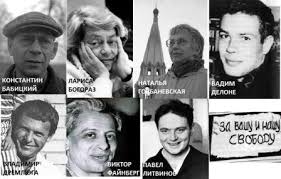
top row: Babitsky, Bogoraz, Gorbanevskaya, Delaunay;
bottom row: Dremlyuga, Fainberg, Litvinov: “For Your Freedom, and for Ours” (placard)
*
WITNESSES
In the course of the judicial investigation the groundlessness of the charges became even more obvious. A group of five men who detained the demonstrators stood out among the principal prosecution witnesses.
They were all from Military Unit 1164. The five of them happened to be on Red Square on 25 August 1968 simultaneously, without prior arrangement. They helped to detain the demonstrators; during the pre-trial investigation they testified that the activities of the demonstrators had disturbed public order.
On the very first day, under cross-examination, these witnesses became confused in their statements about their previous acquaintance with one another. Apparently for this reason, on the second day the three who had not been questioned the first day turned out to be ‘absent on business’. The Court decided not to question them, despite protests from the defendants and their counsel.
*
Another prosecution witness was Oleg Davidovich, an official of the notorious Mordovian strict-regime labour camps (CCE 6.10).
His evidence served as one of the major planks in the prosecution’s case although the description of the demonstration in his statements differed from all the other evidence. He recalled the time as 12.30-12.40 p.m. and claimed to have entered Red Square from the GUM department-store, which, as everyone knows, is closed on Sundays.
*
A local traffic policeman called as a witness was also interesting.
His evidence was important in order to determine whether public transport was disrupted. On 25 August he submitted a report to his superiors on what had occurred; it made no reference to a disruption of transport.
On 3 September 1968 the policeman submitted a new report stating that there had been disruption of transport. As was proven in Court, he had been summoned to the KGB (CCE 5.5) between 25 August and 3 September.
*
CLOSING STATEMENTS
The accused pleaded not guilty.
The examination of the defendants, their closing speeches and the speeches of the defence counsel convincingly proved the absence of any criminality in the activities of the demonstrators.
Procurator Drel devoted the major part of his prosecution speech to the events in Czechoslovakia. The defendants were interrupted every time they referred to these events, describing what motivated their actions or explaining the wording of their slogans.
The prosecutor demanded three years imprisonment for Vladimir Dremlyuga [4] and two years for Vadim Delaunay. To the two years for Delaunay should be added an earlier suspended sentence of one year, of which he had served more than seven months during the investigation, i.e., the total term of imprisonment would be two years and four months [5].
*
As concerns the remaining defendants the prosecutor proposed to invoke Article 43 (RSFSR Criminal Code: “Mitigating circumstances”; see Commentary, below). None of the accused had a previous criminal record: all three had dependent children.
Procurator Drel suggested they be sentenced not to imprisonment but to terms of exile: five years for Pavel Litvinov; four years for Larissa Bogoraz; three years for Konstantin Babitsky.
*
SENTENCES
The Court found the defendants guilty on both charges.
As concerns punitive measures, the Court more than satisfied the demands of the Procurator.
In his closing speech Vadim Delaunay said: “I appeal to this Court not for mercy, but for restraint.” He received six months longer in the camps than the Procurator had proposed, however: 2 ½ years plus the four months of his unserved term, a total of two years and 10 months.
The remaining defendants received terms in camp and exile in accordance with the demands of the Procurator.
The defendants and their counsel lodged appeals.
*
Exile for Babitsky, Bogoraz and Litvinov
A Short Commentary
Articles 190-1 and 190-3 (RSFSR Criminal Code) provide for the following punitive measures: imprisonment for up to three years, corrective labour for up to one year, or a fine not exceeding 100 roubles.
Article 43 of the RSFSR Criminal Code (General Section) states that
“the court, in consideration of the exceptional circumstances of a case and the personality of the guilty person, and deeming it necessary either to punish him or her less severely than the minimum limits envisaged by the law for the given crime, or to apply another, less severe, form of punishment, may permit such a mitigation but must provide an explanation of its reasons for so doing”.
Under the guise of applying Article 43, the court did not impose a less severe form of punishment, but took an average of the punitive provisions of Articles 190-1 and 190-3.
Exile instead of imprisonment, as a result of the application of Article 43, is possible in those cases where a less severe form of punishment than imprisonment is not envisaged by a specific article (e.g. Articles 64-69; 71, 75, 76-81 et al). In this particular case, if the court felt it possible not to sentence the three defendants to imprisonment, it would have been logical to punish them by corrective labour or a fine [6].
Article 319 of the RSFSR Code of Criminal Procedure states:
“on the acquittal of the defendant, or on his or her release or exemption from punishment, or in the case of him or her being sentenced to a punishment not involving imprisonment, the court must, if the defendant is being held in custody, release him or her immediately in the courtroom.”
The verdict of the Moscow City Court stated that Babitsky, Bogoraz and Litvinov would be released from custody on arrival at their places of exile.
*
While awaiting the outcome of their appeals, all five continue to be held in custody in the Lefortovo Prison. Being kept in custody is the severest of the existing measures of restraint.
In his final speech Pavel Litvinov rightly remarked that there was no need to apply this measure. After such an open act as the demonstration of 25 August 1968, it was certain that the demonstrators would not try to escape from the court and the police.
===========================================
NOTES
- In July 1970, Natalya Gorbanevskaya was tried (in her absence) and sentenced to an unspecified period of treatment in a Special Psychiatric Hospital (CCE 15.1).
↩︎ - In years to come, Judge Valentina G. Lubentsova conducted several Moscow trials of rights activists and dissidents, e.g. Vladimir Bukovsky in 1972 (CCE 23.1 & CCE 24.1), Yury Orlov in 1978 (CCE 50.1), and Gleb Yakunin in 1980 (CCE 58.3).
↩︎ - Victor Fainberg would spend the next five years in psychiatric hospitals (CCE 30.9 [5]).
↩︎ - For Vladimir Dremlyuga’s later penal servitude, see CCE 21.1 (August 1971) and CCE 32.19 “To start life anew” (July 1974).
↩︎ - For Vadim Delaunay, see (CCE 5.4 [9]), (CCE 20.11 [6]), and Obituary (1947-1983).
↩︎ - In Judgement in Moscow (2016), Bukovsky documents the intervention (at the request of Pavel Litvinov’s grandmother Ivy) by Anastas Mikoyan and the latter’s appeal to Brezhnev: 4 September 1968.
↩︎
===================
 A Chronicle of Current Events